
Bothell Excess Liability Insurance: Extra Protection For Your Business And Home
Your standard business or homeowners policy likely has coverage limits that stop well short of protecting your full assets. A lawsuit or major accident can quickly exceed those limits, leaving you personally liable for the difference.
Bothell excess liability insurance fills that gap by providing additional protection when your primary coverage runs out. We at First Rate Insurance Plus, Inc. help Bothell residents understand how this extra layer of protection works and why it matters for your financial security.
Why Your Standard Policy Isn’t Enough
How Excess Liability Insurance Works
Excess liability insurance operates as a second line of defense that activates when your primary policy hits its limit. If you face a lawsuit and the judgment exceeds what your homeowners or business policy covers, your personal assets become vulnerable. Excess liability steps in and pays the difference, protecting your savings, investments, home equity, and future earnings from seizure to satisfy a judgment. You pay a relatively modest premium for a large amount of additional protection, typically ranging from $1 million to $5 million depending on your situation.
The Gap Between Coverage and Reality
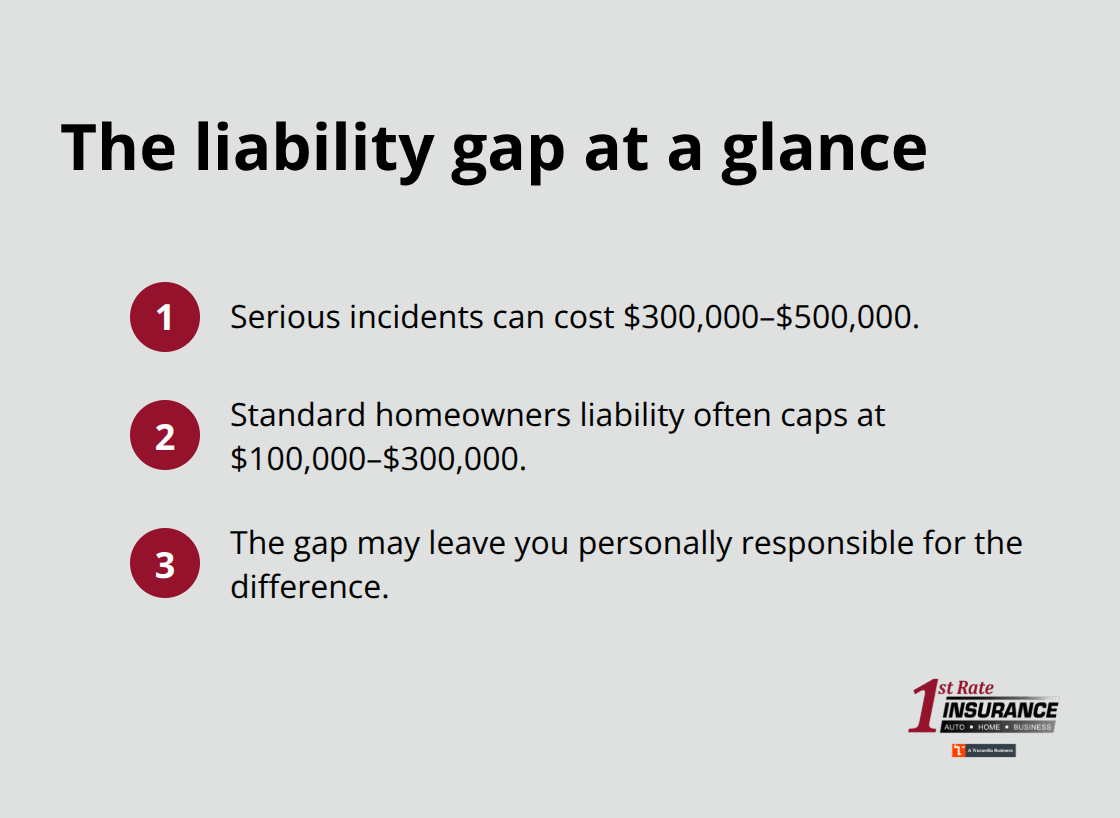
Most Bothell residents dramatically underestimate how quickly legal costs and settlements spiral. A single serious accident, a guest injured on your property, or a dog bite incident can generate medical bills, legal fees, and damages that easily exceed $300,000 to $500,000. Standard homeowners policies typically cap liability at $100,000 to $300,000, leaving a substantial gap between what you’re covered for and what you could actually owe.
The real problem isn’t that major incidents happen frequently-it’s that they happen unpredictably and cost far more than most people anticipate. A single lawsuit can exceed your general liability limits, and jury awards in personal injury cases often reach into the millions.
Business Owners Face Steeper Exposure
Business owners face even steeper exposure than homeowners. If a customer suffers injury at your workplace or your business operations cause property damage, you could face claims well beyond your commercial general liability limit. A $1 million umbrella policy typically costs between $150 and $300 annually for a homeowner with modest risk factors, while a business owner might pay $300 to $600 for the same coverage.
Matching Coverage to Your Assets
Without excess liability protection, a single adverse event can wipe out decades of financial progress. The cost of additional coverage makes financial sense when you consider what you stand to lose. First Rate Insurance Plus, Inc. works with Bothell residents to identify gaps in their current coverage and recommend excess liability limits that align with their actual assets and income level.
Understanding your exposure is the first step. The next step involves evaluating exactly how much excess liability coverage you actually need for your specific situation.
Choosing the Right Excess Liability Product for Your Bothell Situation
Excess liability comes in two distinct forms, and picking the wrong one wastes money or leaves you underprotected. Business owners need commercial umbrella policies, while homeowners should focus on personal umbrella coverage. The distinction matters because commercial policies cover liability arising from business operations, while personal policies protect against claims from your home, vehicles, or personal activities. Bothell residents with rental properties, contractors who work from home, or those who operate side businesses often need both types running simultaneously. A commercial umbrella typically costs $300 to $600 annually for $1 million in coverage, while a personal umbrella for a homeowner runs $150 to $300 for the same limit. The price difference reflects the higher risk exposure businesses carry.
What Commercial Umbrella Policies Actually Cover
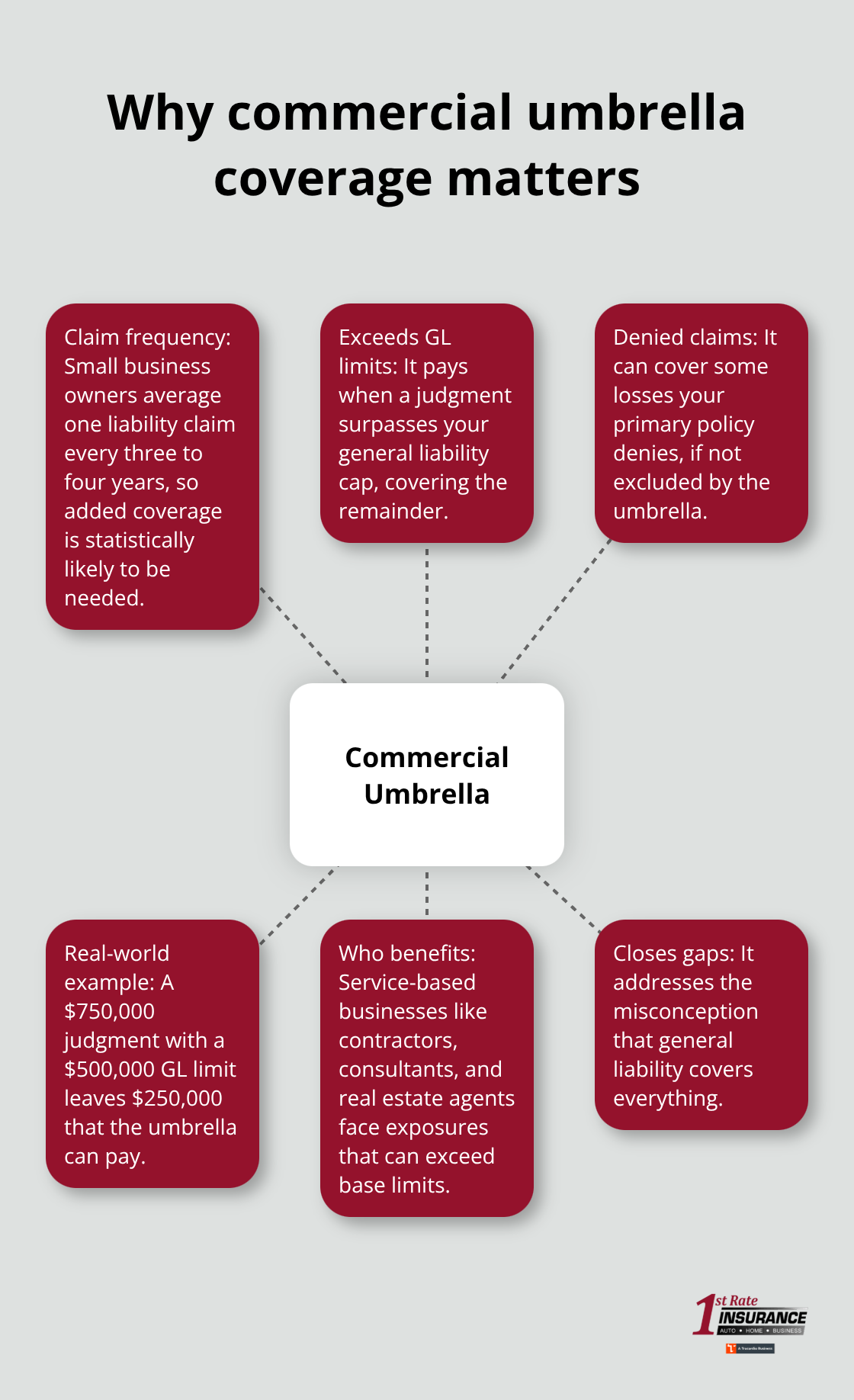
Commercial umbrellas activate after your business general liability policy maxes out. If a customer slips at your retail location and wins a $750,000 judgment but your general liability caps at $500,000, your commercial umbrella pays the remaining $250,000. These policies also cover claims your primary policy denies entirely, provided the umbrella contract doesn’t specifically exclude that type of claim. Many Bothell business owners mistakenly assume their general liability policy handles everything, then discover coverage gaps when a lawsuit arrives. The National Association of Insurance Commissioners data shows small business owners face an average of one liability claim every three to four years, making umbrella coverage statistically probable rather than theoretical. For service-based businesses like contractors, consultants, or real estate agents, commercial umbrellas protect against professional liability claims that exceed your base policy limits.
Personal Umbrellas Protect Your Household Assets
Personal umbrella policies cover liability claims from your home, vehicles, recreational activities, and personal conduct. If your dog bites a neighbor requiring $150,000 in medical care, your homeowners policy might cover only $100,000, leaving your personal umbrella to cover the gap. These policies also extend protection to family members living in your household and cover incidents occurring away from your property. A personal umbrella with $2 million in coverage costs most Bothell homeowners between $200 and $400 annually, representing exceptional value when you consider the assets at risk. The Insurance Information Institute reports that the average homeowners liability claim costs approximately $50,000, but catastrophic claims regularly exceed $500,000. Personal umbrellas become particularly important if you have teenagers driving, host frequent gatherings, or own recreational equipment like boats or ATVs that increase your liability exposure.
High-Risk Activities Demand Additional Scrutiny
Certain activities dramatically increase your liability exposure and require specialized consideration. If you operate a home-based business, rent out a property, maintain a swimming pool, or own exotic pets, standard umbrella policies may exclude or restrict coverage. Some insurers impose exclusions for trampoline injuries, hired or non-owned vehicle incidents, or business-related activities conducted from your residence. A homeowner who hosts regular social gatherings faces different risk than someone living alone, and premium structures should reflect that reality. Your umbrella policy should specifically list what it covers and what it doesn’t, rather than leaving you guessing when an incident occurs.
Finding the Right Coverage for Your Specific Risks
The next step involves assessing your actual assets and determining how much excess liability insurance coverage limits makes sense for your financial situation. Your net worth, income level, and lifestyle all factor into the calculation of adequate coverage limits.
How Much Excess Liability Coverage Do You Actually Need
Calculate Your Protected Assets
Bothell residents often guess at coverage limits rather than calculating them based on actual financial exposure. Start with a straightforward inventory of your assets, then add a cushion for future earnings and unexpected judgments. Your home equity, investment accounts, vehicles, retirement savings, and annual income all factor into the calculation. If you own a $600,000 home with $200,000 in equity, hold $150,000 in investments, earn $80,000 annually, and have vehicles worth $40,000, your total protected assets exceed $470,000 before considering future earnings.
Most financial advisors recommend excess liability limits that cover your net worth plus three to five years of gross income. This formula would suggest a $700,000 to $900,000 umbrella policy in the scenario above. However, this calculation changes dramatically if you own multiple properties, operate a business, or have significant investment portfolios. A Bothell homeowner with $1.2 million in home equity and $500,000 in retirement accounts should seriously consider $2 million in umbrella coverage rather than settling for $1 million.
The cost difference between $1 million and $2 million in coverage typically runs only $100 to $150 annually, making the upgrade financially sensible when your assets justify it.
Review Your Current Primary Coverage Limits
Your current primary coverage limits create the foundation for determining umbrella needs. If your homeowners policy carries a $300,000 liability limit and your business general liability maxes out at $500,000, you already know where your protection ends. Review your actual policy documents rather than relying on memory, since many Bothell residents misremember their exact limits.
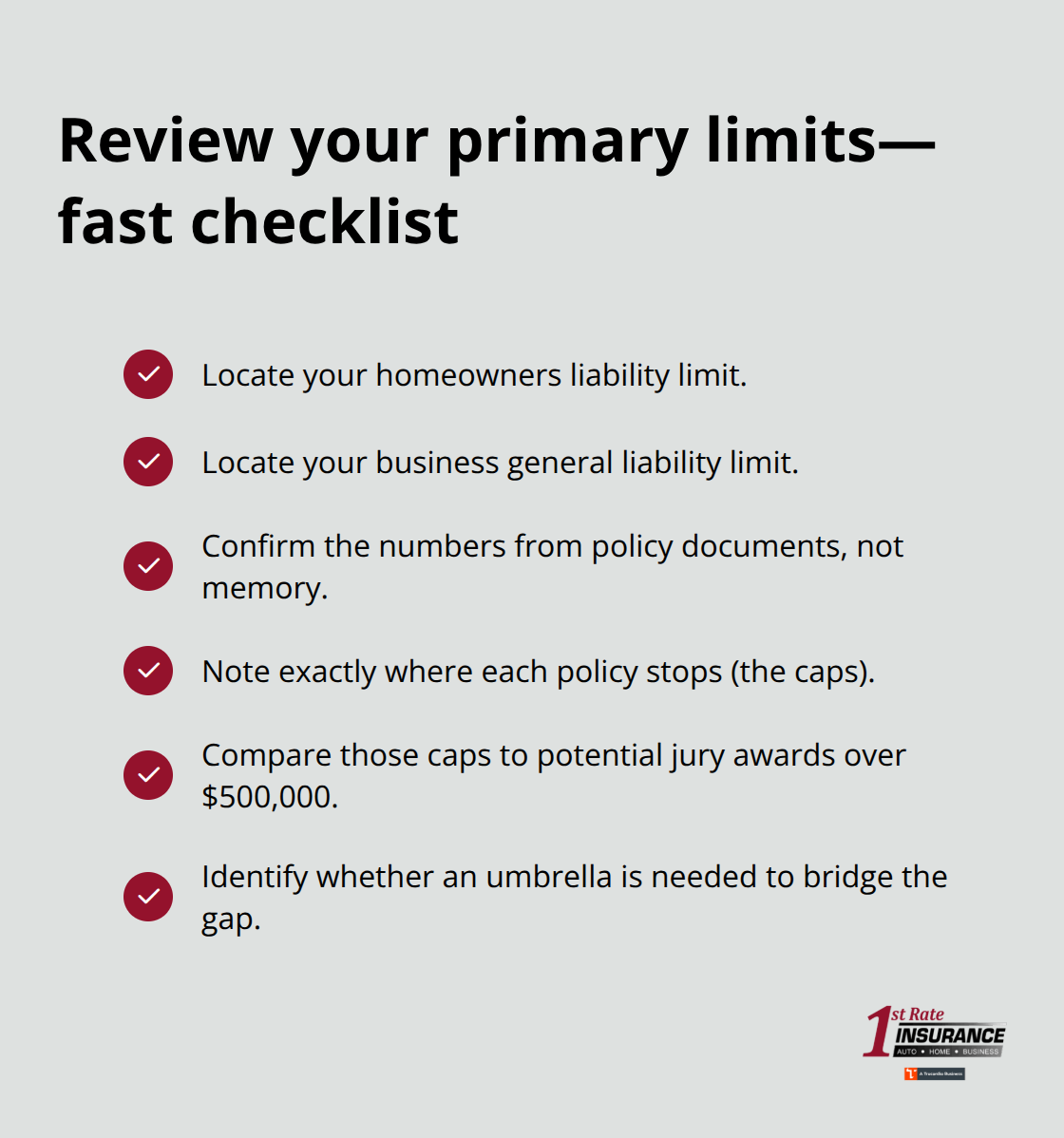
Jury awards in bodily injury cases frequently exceed $500,000 when permanent disability or death occurs. This gap between average claims and catastrophic outcomes explains why umbrella coverage exists.
Determine Adequate Coverage Amounts for Your Situation
We at First Rate Insurance Plus, Inc. recommend Bothell residents with significant assets carry minimum umbrella limits of $1 million, with $2 million becoming standard for anyone with net worth exceeding $750,000. If you rent out a property, operate a home-based business, or have teenage drivers in your household, add another $500,000 to $1 million in coverage to account for elevated risk.
The premium difference between adequate and inadequate coverage often amounts to less than $20 monthly, yet the financial protection difference can reach hundreds of thousands of dollars when a serious claim arrives. Your specific situation-including your assets, income, and lifestyle activities-determines the right coverage floor for your household or business.
Final Thoughts
Bothell excess liability insurance protects what you’ve built by covering claims that exceed your standard policy limits. Without this extra layer, a single lawsuit or serious accident forces you to liquidate savings, investments, and home equity to satisfy a judgment. The financial stakes are real, and the cost of protection is remarkably low compared to what you stand to lose.
Your next step involves reviewing your current homeowners and business policies to identify your actual coverage limits. Write down those numbers, then calculate your total assets including home equity, investments, vehicles, and annual income (this simple exercise reveals whether your current umbrella coverage matches your financial exposure or leaves dangerous gaps). Most Bothell residents discover they’re underprotected once they complete this assessment.
We at First Rate Insurance Plus, Inc. work with individuals and families across Washington to build insurance strategies that actually protect your assets. Contact First Rate Insurance Plus, Inc. to discuss your excess liability coverage today, and our licensed agents will shop multiple carriers to find competitive pricing and coverage tailored to your specific situation.
Disclaimer: The information provided in this blog is for general informational purposes only and does not constitute legal, financial, or insurance advice. Coverage options, terms, and availability may vary. Please consult with a licensed professional for advice specific to your situation. Artificial intelligence may have been used to generate text and images in some blog articles.