
Bellevue Car Insurance Options: Find The Best Fit For Your Drive
Bellevue drivers face unique insurance challenges that go beyond standard coverage. Traffic congestion, seasonal weather shifts, and vehicle theft create real risks that demand thoughtful protection.
At First Rate Insurance Plus, Inc., we help Bellevue residents navigate their car insurance options with clarity. This guide walks you through the coverage types available and how to pick the right policy for your situation.
Why Bellevue Drivers Face Higher Insurance Costs
Traffic Congestion Drives Accident Risk
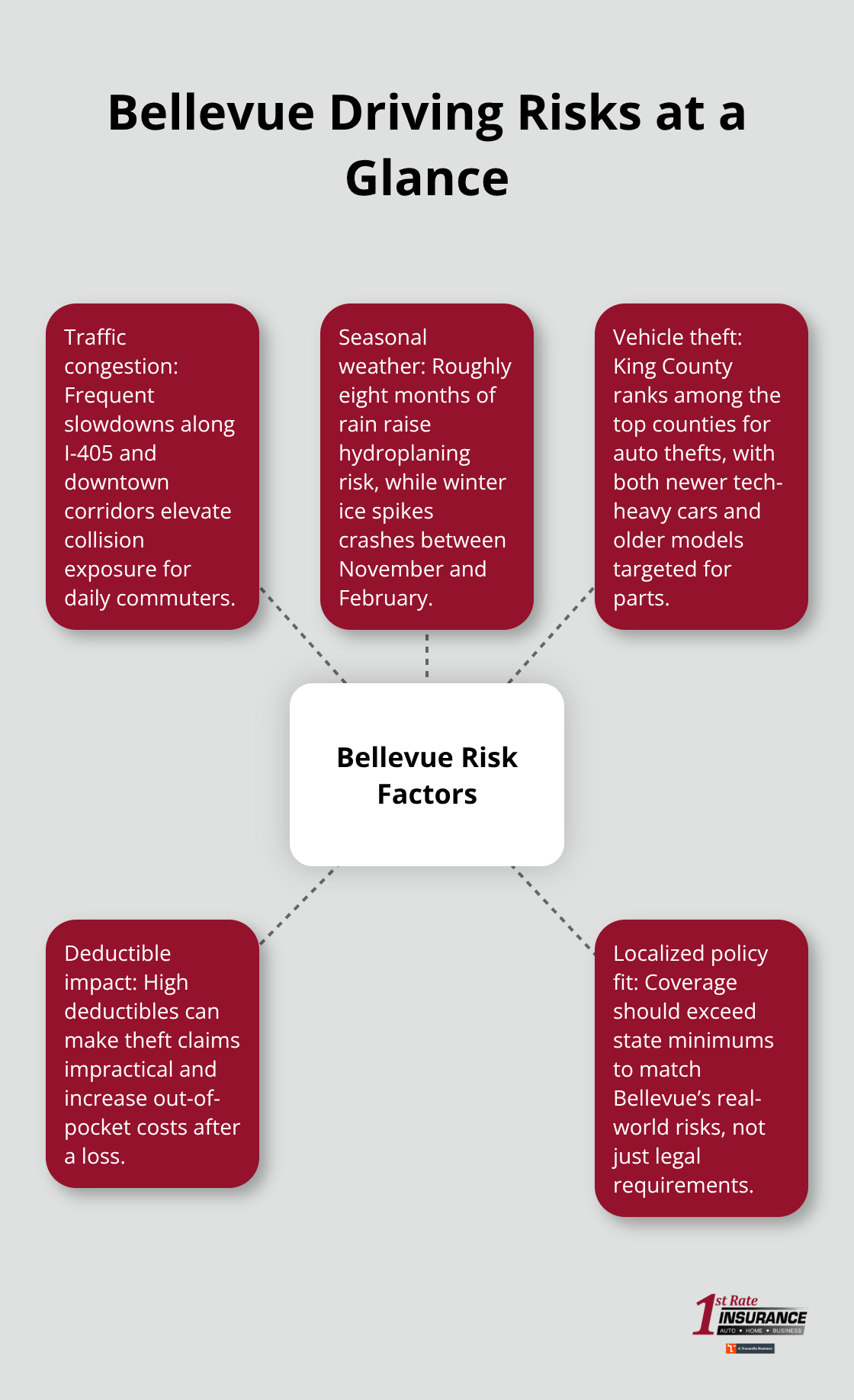
Bellevue sits in one of Washington’s most congested traffic corridors, and that congestion translates directly into accident risk. Compared with other communities in Washington, Bellevue has had a lower rate of fatal and serious injury collisions, with intersection accidents particularly common along I-405 and around downtown retail areas. This elevated accident frequency means your premiums reflect real exposure, not theoretical risk. Collision coverage becomes less of an option and more of a practical necessity when you navigate these roads daily.
Weather Creates Seasonal Hazards
Weather compounds the problem significantly. Bellevue experiences wet conditions roughly eight months per year, and that extended rainy season creates hydroplaning hazards that catch unprepared drivers. Winter months bring occasional ice on elevated stretches of I-405, where accidents spike noticeably between November and February according to Washington State Department of Transportation data. Your comprehensive coverage needs to account for weather-related incidents that feel inevitable rather than exceptional.
Vehicle Theft Threatens Your Protection
Vehicle theft presents another pressing concern specific to this region. King County, where Bellevue is located, ranks among the top counties in Washington for auto thefts, with thieves targeting both newer vehicles with advanced technology and older models for parts. Comprehensive coverage protects against this threat, but too many Bellevue drivers skip it or choose deductibles so high that theft claims become impractical.
Building a Policy That Matches Local Conditions
The combination of congestion, seasonal weather, and theft risk means your policy should reflect where you actually drive, not just the state minimums that satisfy legal requirements. Your deductible choices and coverage limits need adjustment based on these specific Bellevue hazards. Understanding what each coverage type actually protects-and how it applies to local conditions-helps you make informed decisions about your protection level. Contact a qualified agent to review your current protection and explore options tailored to Bellevue’s unique driving environment.
What Coverage Types Protect Bellevue Drivers Best
State Minimums Fall Short in Bellevue’s High-Risk Environment
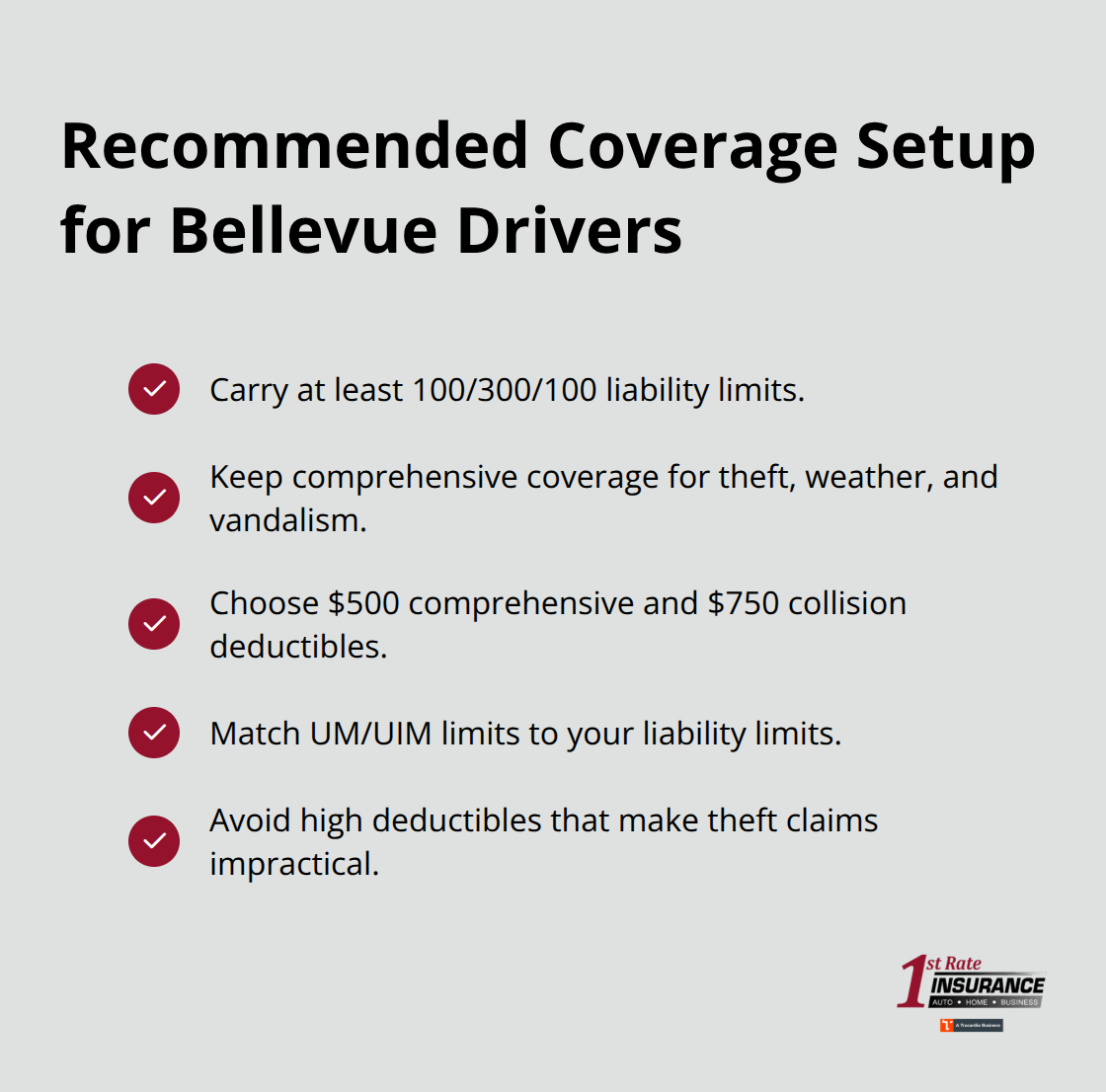
Washington State requires liability coverage minimums of 25/50/25, meaning $25,000 bodily injury per person, $50,000 per accident, and $25,000 property damage. These legal minimums satisfy the state, not your finances. In Bellevue’s congested environment, a single accident can easily exceed these thresholds. Medical costs for serious injuries routinely reach $100,000 or more, and property damage from multi-vehicle collisions on I-405 frequently surpasses the $25,000 limit. First Rate Insurance Plus recommends carrying at least 100/300/100 coverage, which costs only marginally more than the state minimum but shields your personal assets from catastrophic claims.
Collision and Comprehensive Coverage Address Local Threats
Collision coverage pays for damage to your vehicle when you hit another car or object, while comprehensive coverage handles theft, weather damage, and vandalism-exactly the risks that plague Bellevue drivers based on King County theft data and the region’s eight-month rainy season. Your deductible choice matters significantly here. Choosing a $1,000 deductible instead of $500 typically reduces your premium by 15-30% annually, but in Bellevue’s theft-prone area, that savings evaporates quickly if your vehicle gets stolen. Most Bellevue residents benefit from a $500 deductible on comprehensive coverage and $750 on collision, balancing protection against premium costs.
Uninsured and Underinsured Motorist Protection Fills Critical Gaps
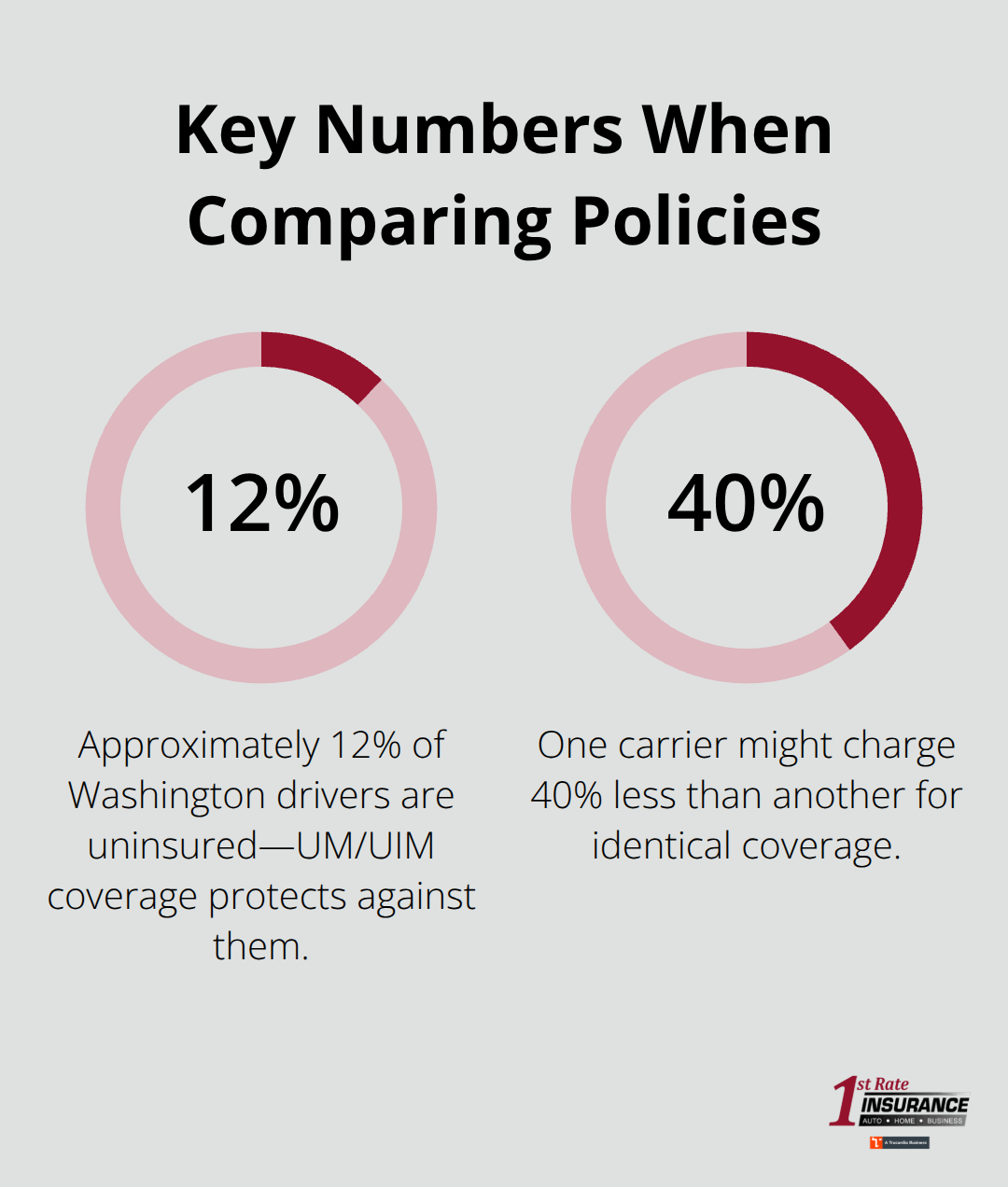
Uninsured and underinsured motorist coverage protects you when another driver lacks adequate insurance or carries none at all. Washington State allows drivers to reject this coverage, yet approximately 12% of Washington drivers remain uninsured according to insurance industry data. In Bellevue’s high-traffic corridors, you’ll encounter an uninsured driver regularly-it’s not theoretical. Uninsured motorist coverage pays your medical bills and vehicle repairs when an uninsured driver causes the accident, while underinsured motorist coverage fills the gap when the at-fault driver’s liability limits fall short of your actual damages. Match your uninsured and underinsured motorist limits to your liability coverage, maintaining that 100/300/100 protection level. This coordinated approach prevents gaps where you’d absorb losses personally.
Tailoring Coverage to Your Bellevue Driving Patterns
Your specific driving patterns-commute routes, frequency, vehicle type-determine which coverage levels actually protect you. An agent can review these factors and recommend coverage that reflects actual Bellevue conditions rather than generic state requirements. The right policy structure depends on whether you navigate I-405 daily during rush hour or drive local streets occasionally. Your vehicle’s age and value also shift the collision versus comprehensive balance. Once you understand how each coverage type applies to your situation, the next step involves comparing what different carriers actually charge for the protection you need.
Matching Coverage to Your Bellevue Situation
Map Your Actual Driving Patterns
Start by mapping your actual driving patterns against the coverage options we outlined. If you commute on I-405 during peak hours five days a week, your risk profile differs dramatically from someone who drives local streets twice monthly. Document your typical routes, annual mileage, and how often you drive during winter months when icy conditions spike accidents. This data becomes your foundation for selecting appropriate coverage levels rather than defaulting to state minimums or copying what a friend carries.
Your vehicle’s age and value shift the equation significantly. A 2022 model justifies comprehensive and collision coverage, while a 2012 vehicle might warrant comprehensive with a higher collision deductible to reduce premiums. Once you know your actual exposure, you’re ready to compare what different carriers charge for the specific protection you need.
Compare Quotes Across Multiple Carriers
Gathering quotes from multiple insurers reveals dramatic pricing variations for identical coverage. Insurance companies weight Bellevue’s accident and theft data differently, and their algorithms reward different driver profiles-one carrier might charge 40% less than another for your exact situation. Obtain quotes from at least three major carriers, ensuring each quote includes the same liability limits, deductible amounts, and coverage selections.
Most insurers offer online quote tools that take 10-15 minutes, though speaking directly with an agent captures discounts you might miss otherwise. When comparing quotes, scrutinize what each carrier actually includes (some bundle roadside assistance while others charge extra, and coverage for rental cars during repairs varies significantly). The cheapest quote isn’t automatically the best choice; verify each carrier’s claims handling reputation through the National Association of Insurance Commissioners complaint database and customer reviews on independent sites like J.D. Power.
Test Different Deductible Combinations
Your deductible choices create the largest premium swings, so test different combinations in each quote. Raising your collision deductible from $500 to $1,000 typically cuts that portion of your premium by 15-25%, but only make that trade if you can actually pay the higher deductible when an accident occurs. For comprehensive coverage in theft-prone King County, a $500 deductible usually makes financial sense given the region’s vehicle theft rates.
Leverage Local Agent Expertise
A local agent shops your specific Bellevue driving situation across multiple carriers simultaneously rather than having you contact each company individually. This approach typically uncovers competitive rates and coverage combinations you wouldn’t find on your own (First Rate Insurance Plus, Inc. works with more than 20 carriers to deliver this advantage to Bellevue residents).
Final Thoughts
Bellevue’s traffic congestion, seasonal weather hazards, and vehicle theft rates demand car insurance coverage that exceeds state minimums. The liability protection, collision and comprehensive coverage, and uninsured motorist protection we’ve outlined create a foundation that shields your finances when accidents happen on I-405 or theft strikes in King County. Your specific driving patterns, vehicle age, and winter driving frequency all influence which deductible levels and coverage limits make financial sense for your situation.
A local agent accelerates your search significantly by shopping your Bellevue car insurance options across multiple carriers simultaneously rather than having you contact each company individually. This approach uncovers competitive rates and coverage combinations you wouldn’t discover on your own, often revealing pricing variations that exceed $500 annually for identical protection. We at First Rate Insurance Plus, Inc. work with more than 20 carriers to deliver this advantage to Bellevue residents, combining competitive pricing with award-winning local service.
Contact First Rate Insurance Plus, Inc. to review your current coverage and explore policies that protect your finances without overpaying for unnecessary protection. Your agent will compare quotes across carriers, explain how each coverage type applies to local conditions, and help you select deductibles that balance protection against premium costs. The right policy structure depends on your specific situation, not generic recommendations-and that’s exactly what a local agent provides.
Disclaimer: The information provided in this blog is for general informational purposes only and does not constitute legal, financial, or insurance advice. Coverage options, terms, and availability may vary. Please consult with a licensed professional for advice specific to your situation. Artificial intelligence may have been used to generate text and images in some blog articles.

