
WA Personal Umbrella Discounts: How Much You Can Save
Your homeowners and auto insurance policies have limits. When a lawsuit or accident exceeds those limits, your personal assets are at risk.
At First Rate Insurance Plus, Inc., we’ve found that Washington residents are leaving significant savings on the table by not understanding WA personal umbrella discounts. Umbrella coverage fills the gap your standard policies leave behind, and bundling it with your existing coverage unlocks real discounts that lower your overall insurance costs.
Understanding Washington Umbrella Insurance
What Umbrella Coverage Actually Protects
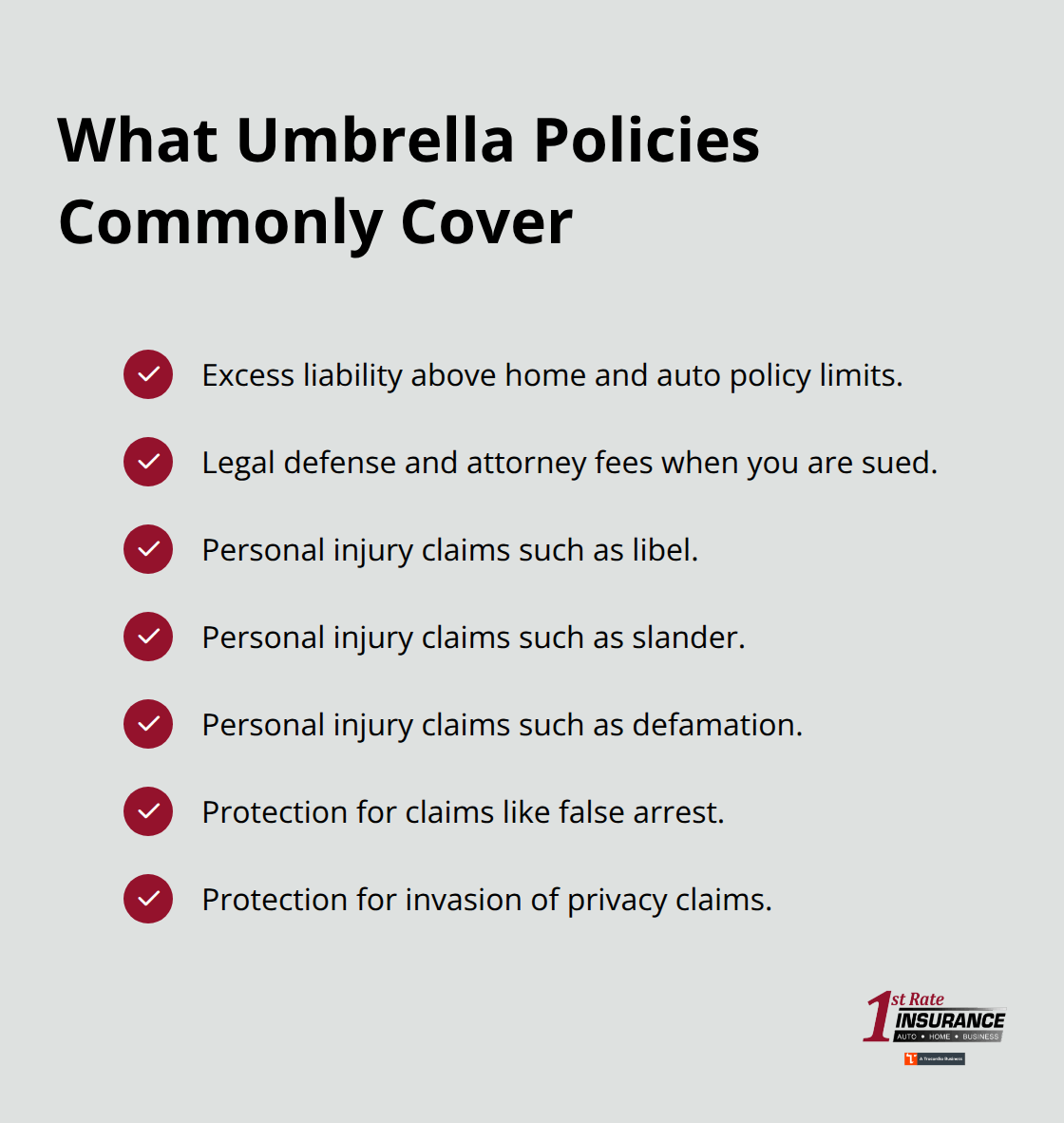
Umbrella insurance activates when your home or auto liability limits are exhausted. If you face liability for injuries or property damage that exceed your primary policy limits, umbrella coverage pays the difference. The policy also covers your legal defense costs and attorney fees when you’re sued. Washington residents often overlook that umbrella policies extend protection beyond typical home and auto scenarios. If someone slips on your property and sues for $750,000 but your homeowners policy caps liability at $300,000, your umbrella fills that $450,000 gap. Umbrella coverage also protects against personal injury claims like libel, slander, defamation, false arrest, and invasion of privacy. These claims rarely appear under standard homeowners or auto policies, leaving you exposed.
A $1 million umbrella policy costs roughly $200 per year according to industry data, making this protection extraordinarily affordable for the liability exposure it covers.
Why Standard Policies Leave Dangerous Gaps
Standard homeowners policies typically include $100,000 to $300,000 in liability coverage. Auto policies usually cap at $250,000 per person and $500,000 per accident. For most Washington families, these limits sound adequate until a serious accident happens. If you cause a multi-car pileup on I-5 with injuries and property damage totaling $800,000, your $250,000 auto policy covers only 31% of the claim. The remaining $550,000 comes directly from your personal assets-your home equity, savings, investments, and future wages. Washington courts don’t hesitate to garnish wages for years to satisfy judgments. Your standard policies also exclude coverage for certain liability scenarios. If your teenage child causes injury while babysitting and the injured party sues for emotional distress claims, your homeowners policy may deny coverage entirely. Umbrella insurance steps in precisely where standard policies stop, protecting the assets you’ve spent decades building. Without it, one lawsuit can wipe out your financial security.
How Umbrella Limits Stack With Your Existing Coverage
Umbrella policies work in layers, not replacement. Your auto and homeowners policies pay first up to their limits, then umbrella coverage activates. If you carry $250,000 auto liability and add a $1 million umbrella, you effectively have $1.25 million in total protection for auto accidents. The umbrella doesn’t duplicate coverage or create redundancy-it extends your protection ceiling. Most insurers require underlying policies to meet minimum liability limits before qualifying for umbrella coverage, typically $250,000 to $300,000 for auto and $300,000 for home.
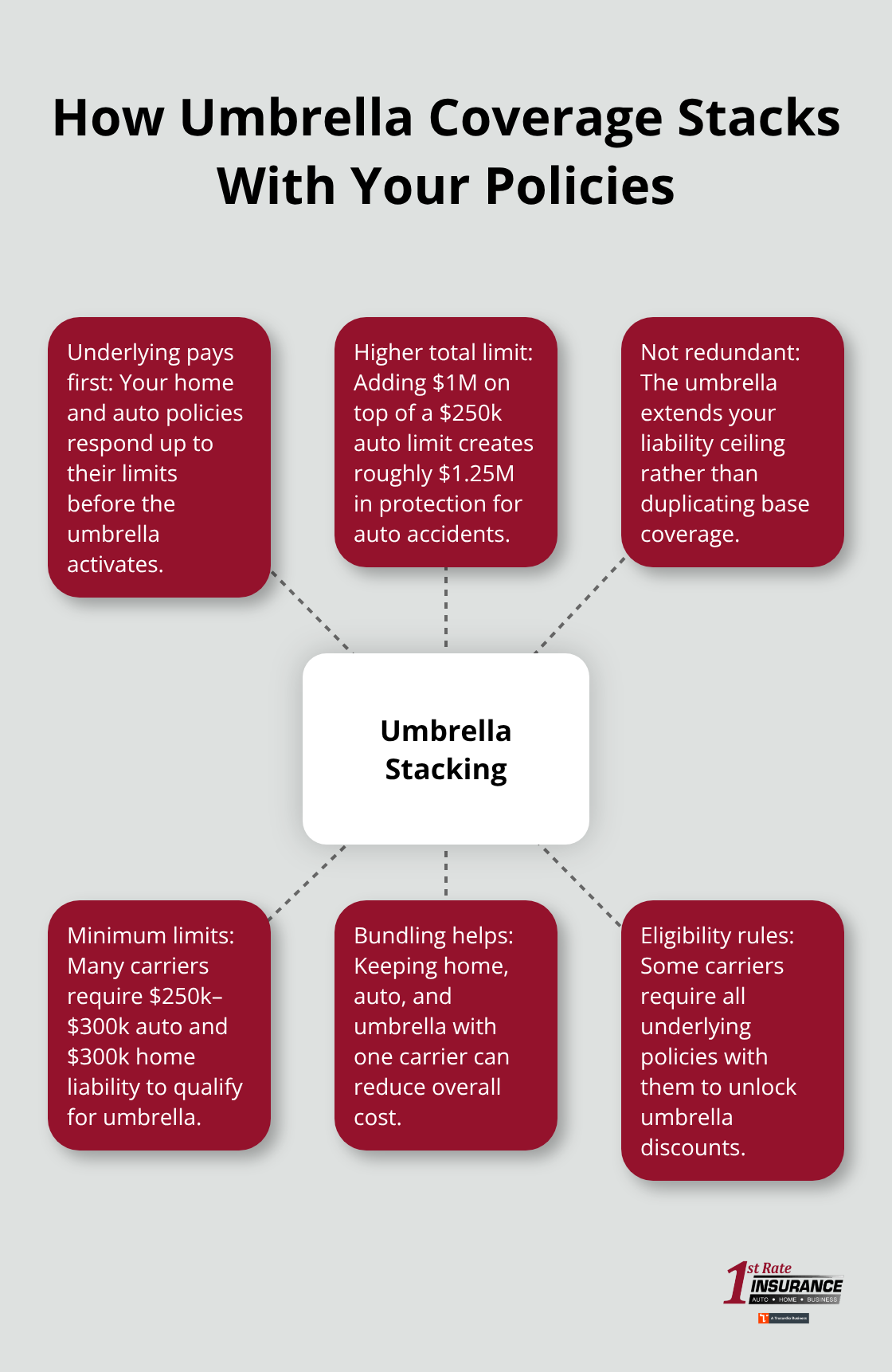
Higher underlying limits often increase umbrella premiums, so bundling all policies with one carrier can reduce your overall cost. Washington residents who bundle auto, home, and umbrella coverage with the same insurer typically see cumulative savings compared to shopping policies separately. Some carriers require you to maintain all policies with them to qualify for umbrella discounts, which can limit your ability to shop around but often delivers better pricing on the umbrella itself. Understanding these stacking mechanics helps you identify which discount opportunities apply to your specific situation.
How to Stack Discounts and Lower Your Umbrella Premium
Consolidate Your Policies for Maximum Savings
Bundling auto, home, and umbrella policies with a single insurer typically delivers the most aggressive discount structure available to Washington residents. Most carriers offer 10% to 25% savings when you combine multiple policies, and umbrella coverage amplifies this benefit because it requires underlying policies anyway. If you currently split your auto policy with one company and homeowners with another, consolidating everything under one roof often reduces your total annual premium by $400 to $800 even before factoring in umbrella-specific discounts. The math works because insurers reward customer loyalty and reduce their administrative costs when managing your entire household risk under one policy management system.
Liberty Mutual offers bundled savings across auto, home, renters, motorcycle, and umbrella when you stack them together, though actual savings depend on your specific risk profile and Washington underwriting criteria. Some carriers impose a bundling requirement to qualify for umbrella coverage at all, meaning you cannot purchase umbrella as a standalone product-you must maintain your auto and home policies with them simultaneously. This restriction frustrates consumers who want to shop around, but it’s the trade-off for accessing the lowest available umbrella rates.
Leverage Your Driving Record and Claims History
Your good driving record and claims history matter significantly when calculating umbrella premiums. Carriers view drivers with zero at-fault accidents and no claims in the past three to five years as substantially lower risk, often qualifying for 10% to 15% additional discounts on umbrella premiums. If you filed a homeowners claim in the past two years, some insurers increase umbrella costs or deny coverage entirely until sufficient time passes.
Invest in Home Safety Features
Safety features in your home-deadbolt locks, security systems monitored by professional services, fire sprinklers, and updated electrical systems-qualify for modest discounts on homeowners liability and occasionally influence umbrella pricing favorably. Installing a monitored security system can reduce your homeowners premium by 5% to 10%, and that lower underlying liability limit sometimes translates to slightly reduced umbrella costs as well.
Compare Quotes Across Multiple Carriers
Washington residents should contact their current insurers directly to identify which specific discounts apply to their household, since availability varies by carrier and underwriting rules change frequently. Getting a quote through an independent agent who represents multiple carriers gives you visibility into discount variations across Liberty Mutual, Travelers, and regional Washington-focused insurers, helping you identify which bundling strategy delivers the lowest total cost for your situation. An independent agent can also help you understand how your specific assets and liability exposure affect which discount combinations matter most for your household.
What Washington Families Actually Pay for Umbrella Protection
The True Cost of Umbrella Coverage
A Washington family with $250,000 auto liability, $300,000 home liability, and no umbrella coverage faces a $550,000 gap if they cause a serious accident that generates $800,000 in damages. Adding a $1 million umbrella policy typically costs $150 to $300 per year for most households, which works out to roughly $12 to $25 per month. This modest premium protects against catastrophic financial loss that could otherwise devastate your household for decades.
Bundling Delivers Substantial Savings
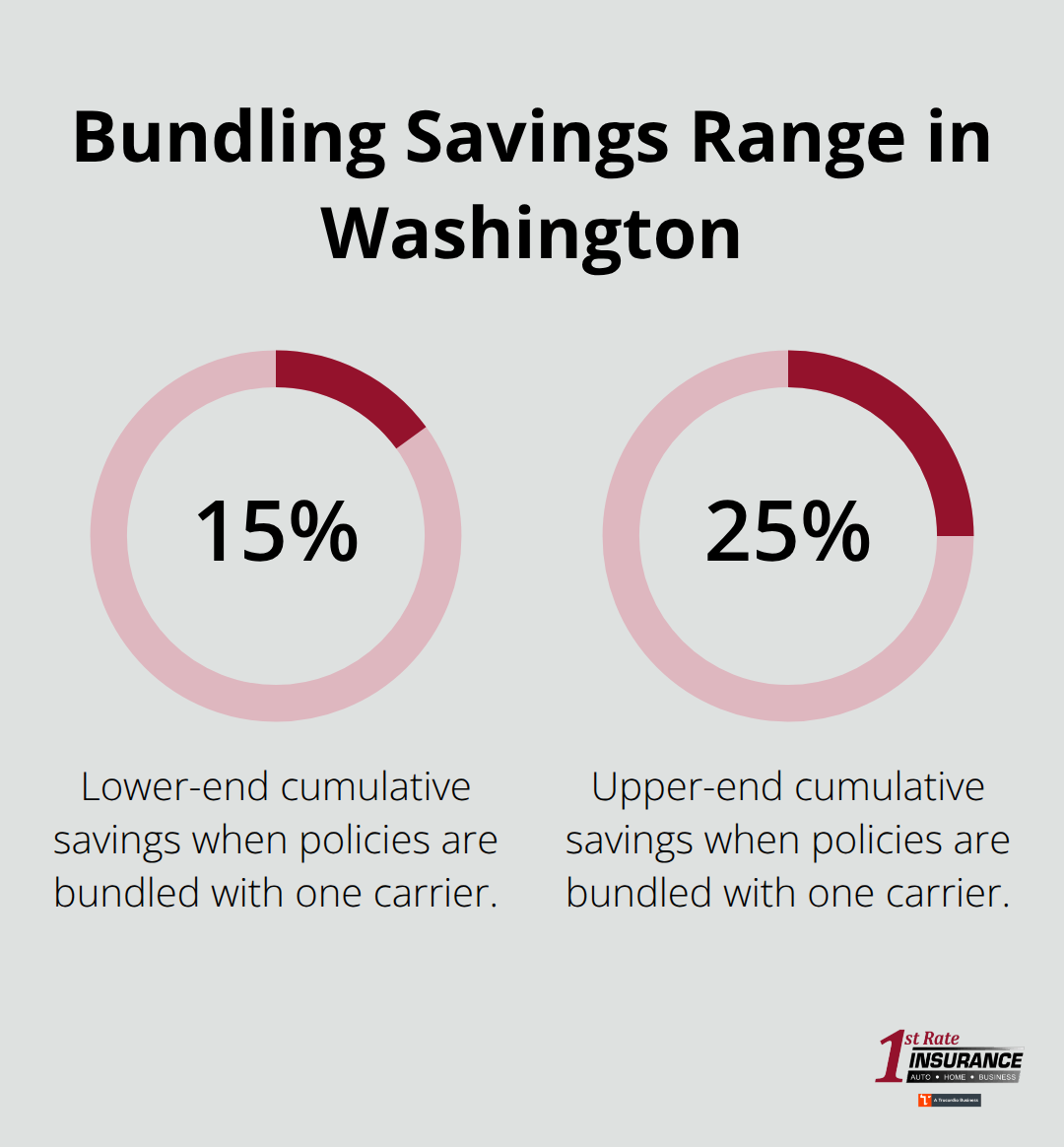
Consolidating auto, home, and umbrella with one insurer often produces 15% to 25% cumulative savings compared to splitting policies across carriers. A Washington family paying $1,200 annually for auto and $900 for homeowners insurance might see their combined premium drop to $1,800 to $1,900 when adding umbrella coverage through the same company, meaning the umbrella itself costs only $100 to $200 per year instead of the standalone rate. This bundling advantage disappears if you maintain policies with different insurers, since most carriers require underlying coverage with them to qualify for umbrella discounts.
Travelers and other major carriers operating in Washington apply similar bundling incentives, though specific discount percentages vary based on your location within the state and individual underwriting factors.
Comparing Protection Costs to Liability Exposure
Without umbrella coverage, a $1 million judgment exceeding your policy limits means you personally owe the difference through wage garnishment, asset seizure, or settlement negotiations that could span decades. With umbrella coverage costing roughly $200 annually, you spend $1,000 over five years to protect against losing your home equity, retirement savings, and future income. Washington residents with substantial assets, rental properties, or teenage drivers operating vehicles face significantly higher liability risk and should prioritize umbrella coverage as non-negotiable protection rather than optional add-on.
Finding Your Best Rate
An independent insurance agent representing multiple Washington carriers can run quote comparisons showing exactly which bundling strategy delivers the lowest total premium for your household, since discount eligibility and percentages vary considerably based on your specific driving record, claims history, and home safety features. First Rate Insurance Plus, Inc., a Kirkland-based personal insurance agency, shops more than 20 carriers to deliver tailored policies and competitive pricing for Washington families seeking umbrella protection. Agents at firms like First Rate Insurance Plus, Inc. help you identify which discount combinations matter most for your situation and ensure you’re not overpaying for coverage you need.
Final Thoughts
Washington umbrella insurance protects your assets when liability claims exceed your standard policy limits, and WA personal umbrella discounts make this protection affordable for most households. A $1 million umbrella policy costs roughly $200 annually, yet shields you from catastrophic financial loss that could otherwise consume decades of earnings and savings. Bundling auto, home, and umbrella coverage with one insurer typically delivers 15% to 25% cumulative savings compared to splitting policies across carriers, meaning your umbrella protection often costs only $100 to $200 per year when combined with existing coverage.
Your good driving record, claims-free history, and home safety features qualify you for additional discounts that reduce your total premium further. Washington residents with substantial assets, rental properties, or teenage drivers operating vehicles face significantly higher liability exposure and should prioritize umbrella coverage as essential protection rather than optional add-on. The gap between your current policy limits and potential liability judgments represents real financial risk that umbrella coverage eliminates at minimal cost.
Contact First Rate Insurance Plus, Inc. today to compare quotes and protect your assets with affordable umbrella coverage tailored to your household’s specific liability exposure. An agent can show you exactly which bundling strategy delivers the lowest total premium for your household, since discount eligibility and percentages vary based on your specific driving record, claims history, and home characteristics. First Rate Insurance Plus, Inc. shops multiple carriers to deliver tailored policies and competitive pricing for Washington families seeking umbrella protection.
Disclaimer: The information provided in this blog is for general informational purposes only and does not constitute legal, financial, or insurance advice. Coverage options, terms, and availability may vary. Please consult with a licensed professional for advice specific to your situation. Artificial intelligence may have been used to generate text and images in some blog articles.
