

Kirkland Personal Umbrella Policy: Expanded Protection For Your Finances
Your standard homeowners or auto insurance policy has limits. When a lawsuit exceeds those limits, your personal assets face real danger.
A Kirkland personal umbrella policy fills that gap by providing additional liability coverage that protects your savings, home, and future income. We at First Rate Insurance Plus, Inc. help Kirkland residents understand exactly how much protection they need and why it matters.
How Umbrella Insurance Actually Works
A personal umbrella policy provides additional liability coverage that activates after your homeowners or auto policy limits are exhausted. Most umbrella policies start at $1 million in coverage, though you can purchase higher limits. The annual cost for $1 million typically ranges from $150 to $300 per year, making it remarkably affordable compared to the protection it provides. This low cost exists because umbrella policies only pay after your underlying coverage depletes, so insurers rarely face claims.
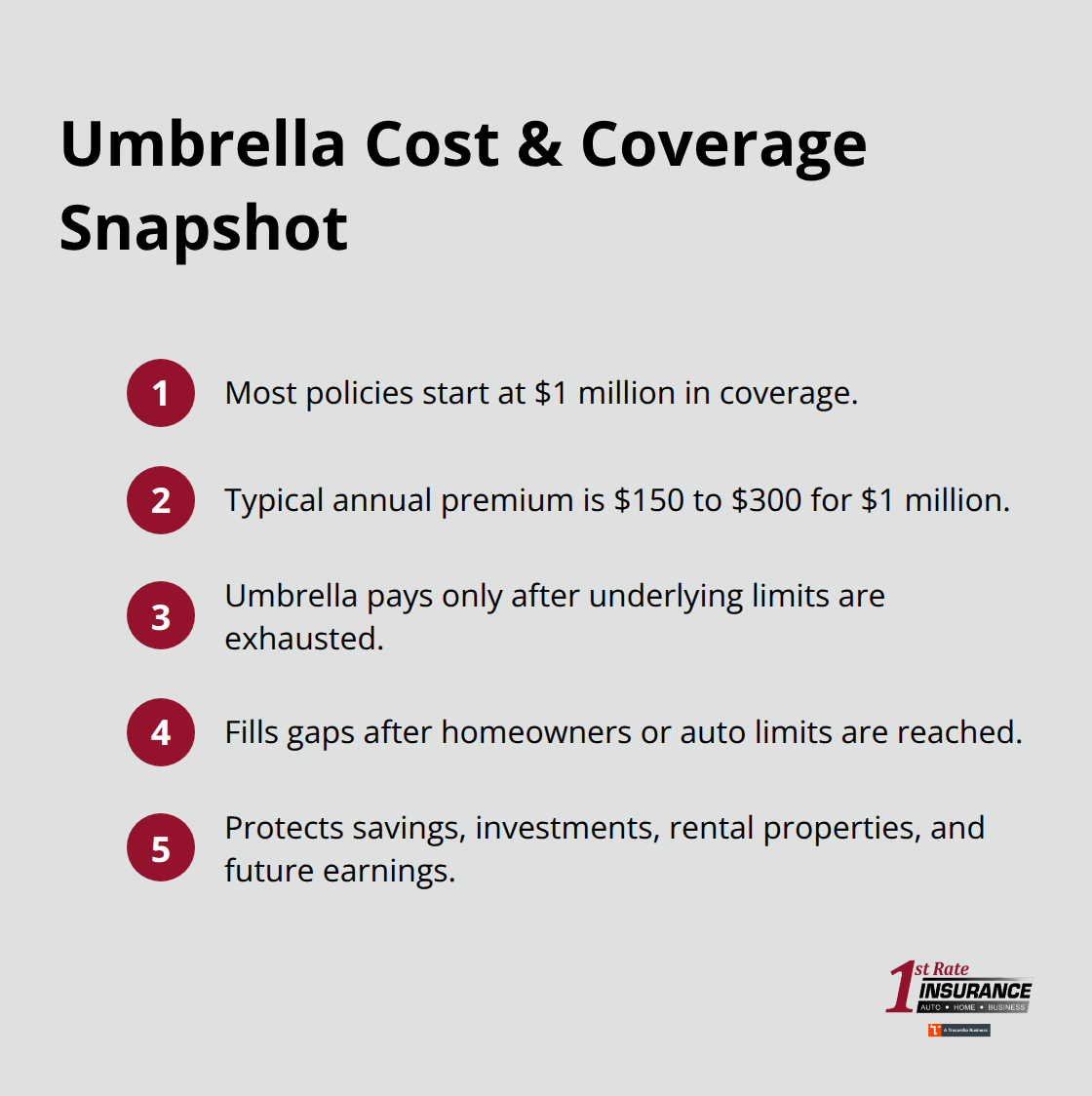
For example, if you cause a $1.5 million car accident and your auto policy covers $500,000, your umbrella policy covers the remaining $1 million. The coverage protects your savings, investments, rental properties, and future earnings from judgments and settlements that exceed your standard policy limits.
What Your Umbrella Actually Covers
Umbrella policies cover bodily injury liability, property damage liability, and personal liability claims including libel, slander, false arrest, and mental anguish. They also typically cover legal defense costs, which in serious personal injury cases can reach $50,000 to $150,000 before settlement according to data from the National Association of Insurance Commissioners. This means your umbrella doesn’t just cover the final judgment-it protects you from the mounting legal expenses during the lawsuit itself.
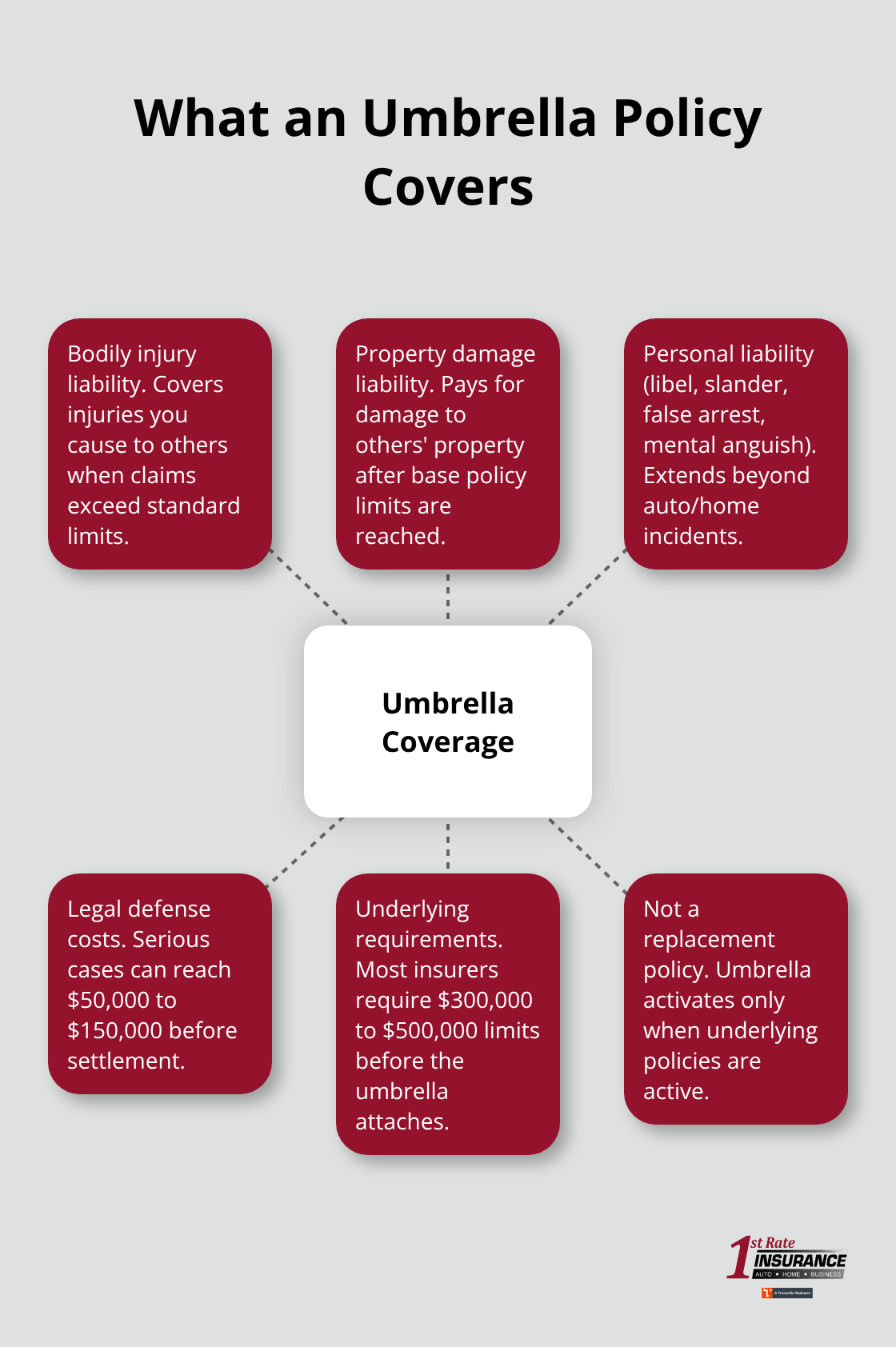
However, umbrella policies only work when your underlying policies remain active. Most insurers require minimum underlying coverage limits, commonly $300,000 to $500,000 on homeowners and auto policies, before they attach an umbrella. Many people mistakenly believe umbrella insurance replaces their standard policies or provides standalone coverage. This misconception leads to inadequate protection because without active homeowners and auto policies, the umbrella has nothing to sit on top of and won’t activate.
Determining Your Coverage Needs
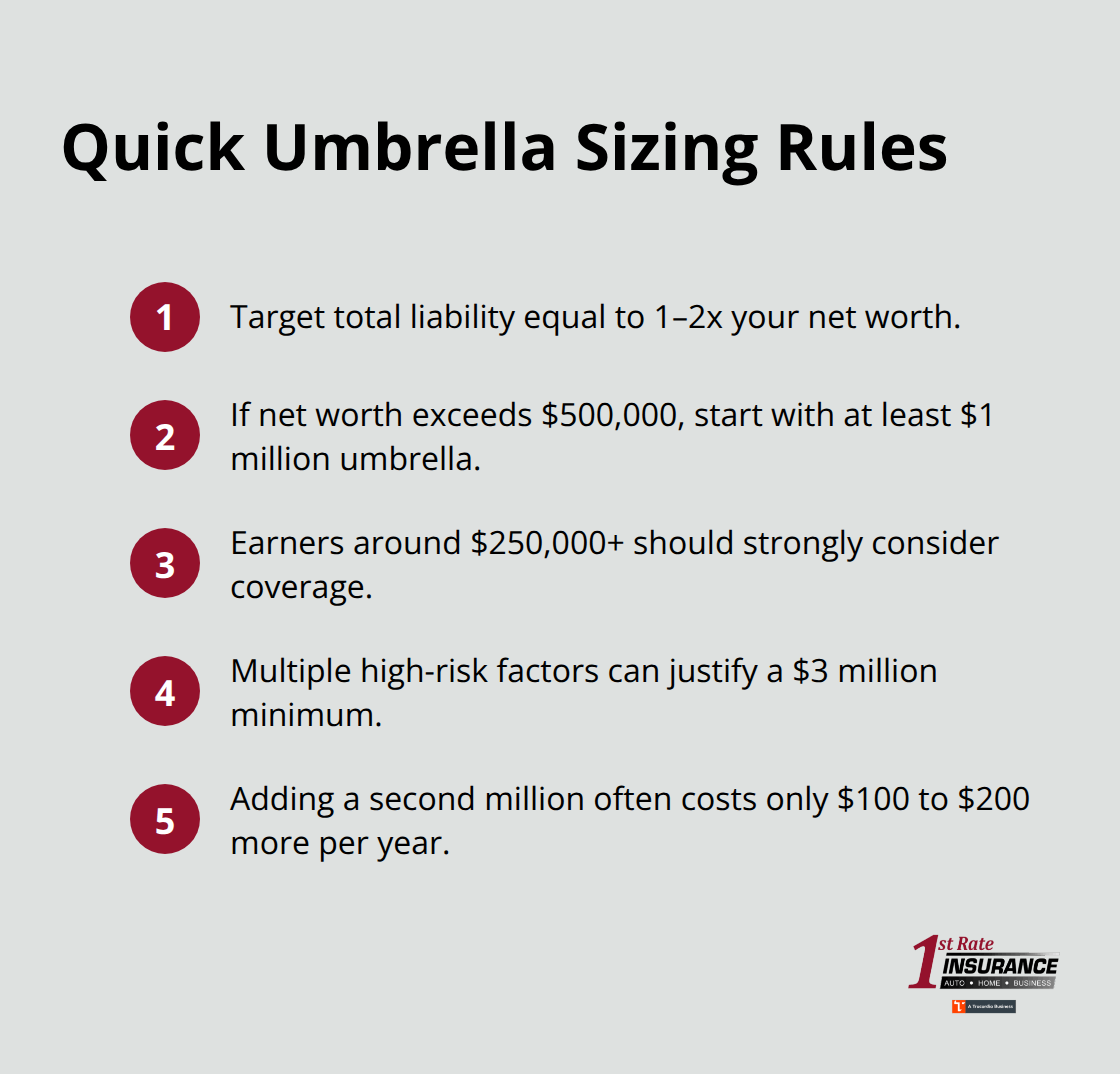
The practical rule of thumb is to try for total liability coverage equal to one to two times your net worth across your umbrella and regular policies. If you have $500,000 in assets, you should target $500,000 to $1 million in total liability coverage. For net worth exceeding $500,000, start with at least $1 million in umbrella coverage, then scale upward based on your specific liability exposure and income level. Those earning around $250,000 or more annually should seriously consider at least a minimal umbrella policy because plaintiffs’ attorneys pursue assets more aggressively against higher-income households. Real-world claims often exceed standard coverage limits-catastrophic cases involving pool drownings, serious auto crashes, or significant premises injuries frequently result in settlements between $2 million and $5 million. The Insurance Information Institute reports that liability claims exceeding $1 million have become increasingly common in catastrophic cases. Washington State residents should factor in whether you own rental properties, host frequent guests, operate a pool, or have teenage drivers in your household (all situations that dramatically increase your liability exposure and should influence your coverage decision).
Specific Risk Factors That Shape Your Decision
Your household composition and activities matter significantly when you calculate umbrella needs. Teenage drivers present substantial exposure-the CDC reports motor vehicle crashes are the leading cause of death for teenagers, making this risk factor worth serious consideration. Rental properties create additional liability scenarios beyond your primary residence. Pools, boats, and off-road vehicles all increase the probability that someone suffers injury on your property or due to your actions. When you combine high income with these risk factors, the case for umbrella coverage becomes even stronger. Licensed agents at First Rate Insurance Plus, Inc. shop more than 20 carriers to help you identify which specific exposures matter most for your situation and which coverage limits actually protect your financial future.
Why Kirkland Residents Face Real Liability Exposure
Washington State presents distinct liability challenges that standard homeowners and auto policies simply don’t address adequately. The state’s growing population density means more neighbors, more guests on properties, and more interaction on roadways-all increasing the likelihood of accidents that trigger lawsuits. Washington’s courts have become increasingly plaintiff-friendly, with jury awards in serious personal injury cases frequently reaching substantial amounts. A single at-fault car accident involving a teenager or a guest injury on your property can spiral into a claim that far exceeds your standard coverage limits.
Real Claims That Exceeded Standard Coverage
Consider a real scenario: a guest slips on your icy driveway in winter and suffers a serious injury requiring ongoing care. Your homeowners policy covers $300,000 in liability, but the medical bills and lifetime care costs total $700,000-exactly what happened in an actual claim against a Kirkland homeowner. Without umbrella coverage, you face personal asset seizure to cover the $400,000 gap. Another documented case involved a motorcycle accident that resulted in a $20 million lifetime care award to the injured party. These aren’t hypothetical disasters; they’re outcomes that have occurred in Washington communities similar to Kirkland, where affluent neighborhoods with pools, rental properties, and active social lives create multiple liability exposure points.
The Gap Between Standard Limits and Actual Claims
Most Kirkland residents carry homeowners liability limits between $100,000 and $300,000 and auto liability between $100,000 and $250,000. Those numbers sound substantial until you face a serious lawsuit. A parent posted disparaging remarks online about a business and faced a $750,000 claim-a personal liability scenario that exceeds standard homeowners coverage and has nothing to do with a car or home damage. Defense costs in serious personal injury cases can significantly deplete your liability limit before any settlement is reached. Your standard policy pays those defense costs from your liability limit, meaning a $300,000 homeowners policy covers only a portion of actual damages after legal fees are deducted.
How Umbrella Coverage Protects Your Assets
Umbrella coverage fills this gap by providing an additional $1 million or more in protection that activates after your underlying policies reach their limits. The protection extends to your savings, investments, and future income-assets that plaintiffs’ attorneys actively pursue when standard coverage runs dry. For Kirkland residents with significant net worth, rental properties, or high-risk activities like frequent guest hosting or pool maintenance, this gap between standard coverage and real-world claim costs represents genuine financial vulnerability. Understanding your specific liability exposure allows you to calculate exactly how much umbrella protection you actually need.
How Much Umbrella Coverage Do You Actually Need
Start With Your Total Net Worth
Your total net worth determines your financial vulnerability if a lawsuit succeeds. Add up your savings, investments, home equity, rental properties, vehicles, and any other assets to reach this number. The National Association of Insurance Commissioners reports that defense costs in serious personal injury cases average $50,000 to $150,000 before settlement, meaning your standard policy limit erodes quickly before any damages are paid. A practical rule suggests targeting total liability coverage equal to one to two times your net worth.
If you have $750,000 in assets, try for $750,000 to $1.5 million in combined coverage across your homeowners, auto, and umbrella policies. For Kirkland residents with net worth exceeding $500,000, starting with at least $1 million in umbrella coverage is non-negotiable. Those earning $250,000 or more annually face heightened risk because plaintiffs’ attorneys specifically pursue affluent households more aggressively. Your income matters as much as your assets because future earnings represent what courts can target through wage garnishment and asset liens.
How Household Composition Increases Your Exposure
Your specific household composition and activities should push your coverage higher than the baseline calculation suggests. A teenage driver in your home increases exposure substantially given that motor vehicle crashes represent the leading cause of death for teenagers according to CDC data. Rental properties create separate liability scenarios beyond your primary residence. Pools, boats, or frequent guest entertainment multiply accident probability significantly.
A single drowning incident, serious guest injury, or at-fault accident involving your teenage child can easily generate claims in the $2 million to $5 million range based on real-world settlements. The Insurance Information Institute documents that liability claims exceeding $1 million have become increasingly common in catastrophic cases. If you own a pool and host regular gatherings, your umbrella coverage should reflect that exposure by starting at $2 million rather than $1 million.
Multiple Risk Factors Demand Higher Limits
If you have multiple risk factors combined, $3 million in umbrella coverage becomes the reasonable minimum. The annual cost difference between $1 million and $2 million in umbrella coverage typically runs only $100 to $200 per year, making the incremental protection remarkably cost-effective. This modest expense protects substantially more of your financial future against catastrophic claims.
Licensed agents assess your specific risk profile across more than 20 carriers to identify which coverage level actually protects your financial future rather than simply meeting a baseline threshold.
Final Thoughts
A Kirkland personal umbrella policy protects what you’ve built by filling the gap between standard coverage limits and real-world claim costs. Settlements regularly exceed $1 million in catastrophic cases, and your homeowners and auto policies alone won’t cover that damage. Without umbrella protection, plaintiffs’ attorneys pursue your savings, investments, and future income to satisfy judgments.
The cost makes this decision straightforward. Annual premiums for $1 million in coverage typically run $150 to $300, and adding a second million costs only $100 to $200 more per year. That modest expense protects substantially more of your financial future than standard policies alone, since umbrella coverage only activates after your underlying policies are exhausted.
We at First Rate Insurance Plus, Inc. help Kirkland residents determine exactly how much protection they need by assessing their specific assets, income, and household composition. Contact us today to discuss your net worth, liability exposure, and coverage goals, and we’ll provide a personalized quote that reflects your actual financial vulnerability.
Disclaimer: The information provided in this blog is for general informational purposes only and does not constitute legal, financial, or insurance advice. Coverage options, terms, and availability may vary. Please consult with a licensed professional for advice specific to your situation. Artificial intelligence may have been used to generate text and images in some blog articles.
