
Umbrella Coverage for Families: Practical Protection You Can Rely On
Your home and auto insurance policies have limits. When someone sues your family for more than those limits cover, you’re personally responsible for the difference.
At First Rate Insurance Plus, Inc., we see families underestimate their liability exposure every day. Umbrella coverage for families bridges that gap, protecting your assets when standard policies run out.
What Makes Your Current Coverage Insufficient
Your homeowners policy likely caps liability at $100,000 to $300,000, while auto insurance typically maxes out at $100,000 per person. These limits sound adequate until you face a serious incident. A single lawsuit from a car accident, a guest injured at your home, or property damage you cause can easily exceed these thresholds. According to the Insurance Information Institute, the average homeowners liability claim costs $35,000, but catastrophic cases routinely reach into the millions. If someone wins a judgment against you for $500,000 and your policy only covers $300,000, you personally owe the remaining $200,000 from your savings, investments, and future wages.
Why Standard Limits Fall Short Today
Standard policy limits were designed decades ago when homes were smaller and vehicles caused less damage. Modern litigation costs have skyrocketed. A homeowner in Washington faced a $2.1 million lawsuit after a guest suffered a serious injury on their property-a case that easily exceeded typical coverage. Medical costs alone have inflated dramatically; a single catastrophic injury claim can involve years of rehabilitation, lost wages, and ongoing care expenses that dwarf traditional policy limits. Additionally, juries increasingly award substantial damages for pain and suffering, not just medical bills.
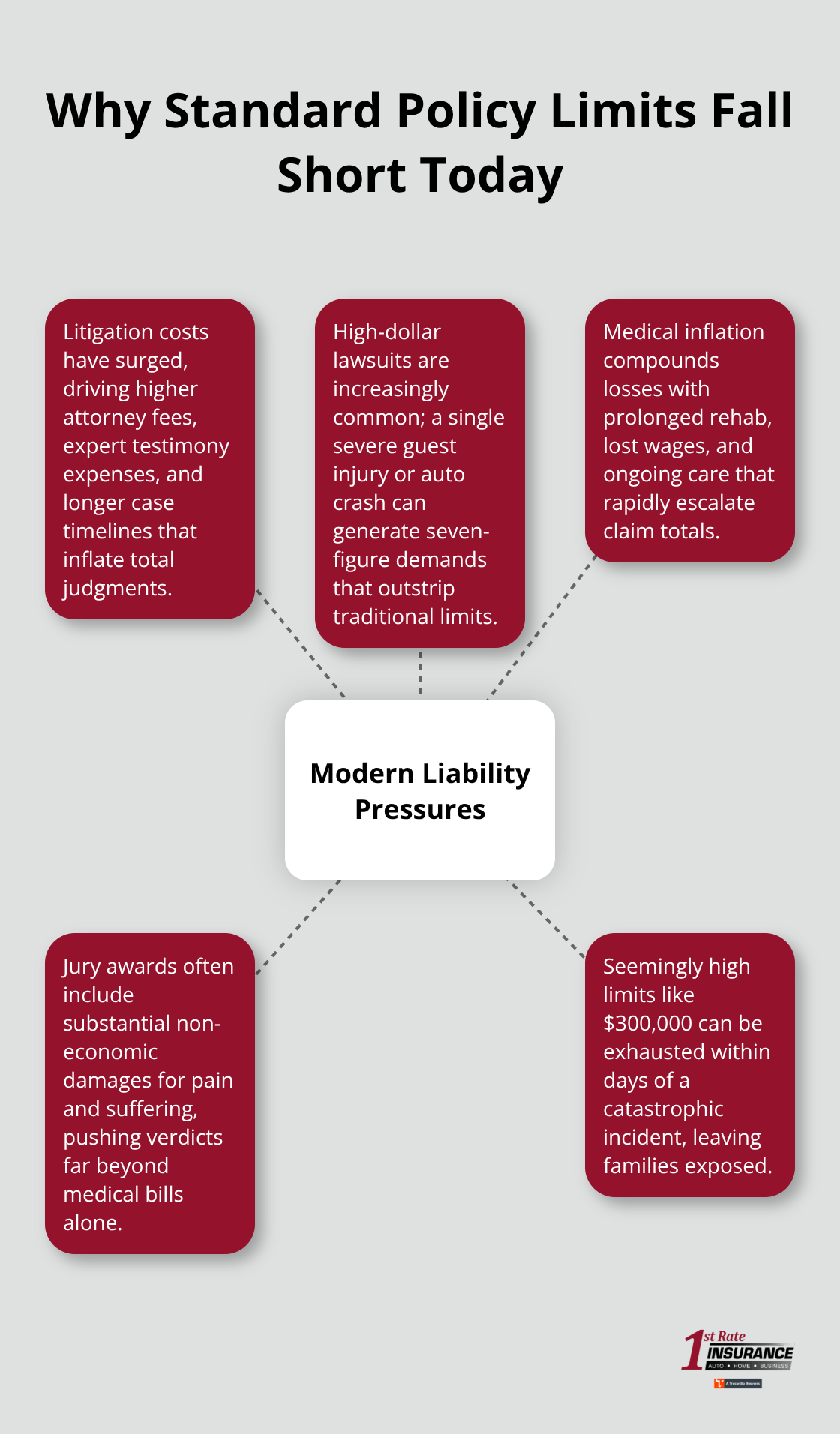
Your $300,000 homeowners limit disappears within days of a serious incident, leaving your family vulnerable.
Identifying Your Personal Liability Gaps
Most families underestimate their liability risk. Do you have a pool, trampoline, or frequently host guests? Do you have teenage drivers? These factors multiply your exposure significantly. Beyond property liability, you face personal liability-if someone sues you for defamation, false arrest, or invasion of privacy, standard policies often exclude these claims entirely. Umbrella coverage extends protection across these gaps and covers situations that your base policies won’t touch.
Finding the Right Coverage Amount
Families with assets exceeding $500,000 should seriously consider umbrella policies starting at $1 million in coverage. For families with higher net worth or riskier exposures (think frequent entertaining or multiple drivers), $2 million to $5 million becomes standard. The cost is surprisingly modest-typically $150 to $300 annually for $1 million in additional coverage-making this protection extraordinarily cost-effective against financial devastation. Licensed agents at First Rate Insurance Plus, Inc. shop more than 20 carriers to find competitive pricing and tailored umbrella policies that match your specific situation.
Understanding your exposure sets the stage for the next critical step: learning exactly how umbrella coverage works and what incidents it actually protects.
How Umbrella Coverage Actually Works
Umbrella insurance sits on top of your existing home and auto policies, activating only after your underlying coverage reaches its limit. Here’s the practical reality: if you cause a car accident and the injured party wins a $750,000 judgment, your auto policy pays its maximum-say $100,000-and umbrella coverage kicks in to cover the remaining $650,000. The umbrella doesn’t replace your base policies; it extends protection beyond them. This layering matters because umbrella policies require you to maintain minimum underlying limits, typically $250,000 to $300,000 on auto and $300,000 on homeowners.
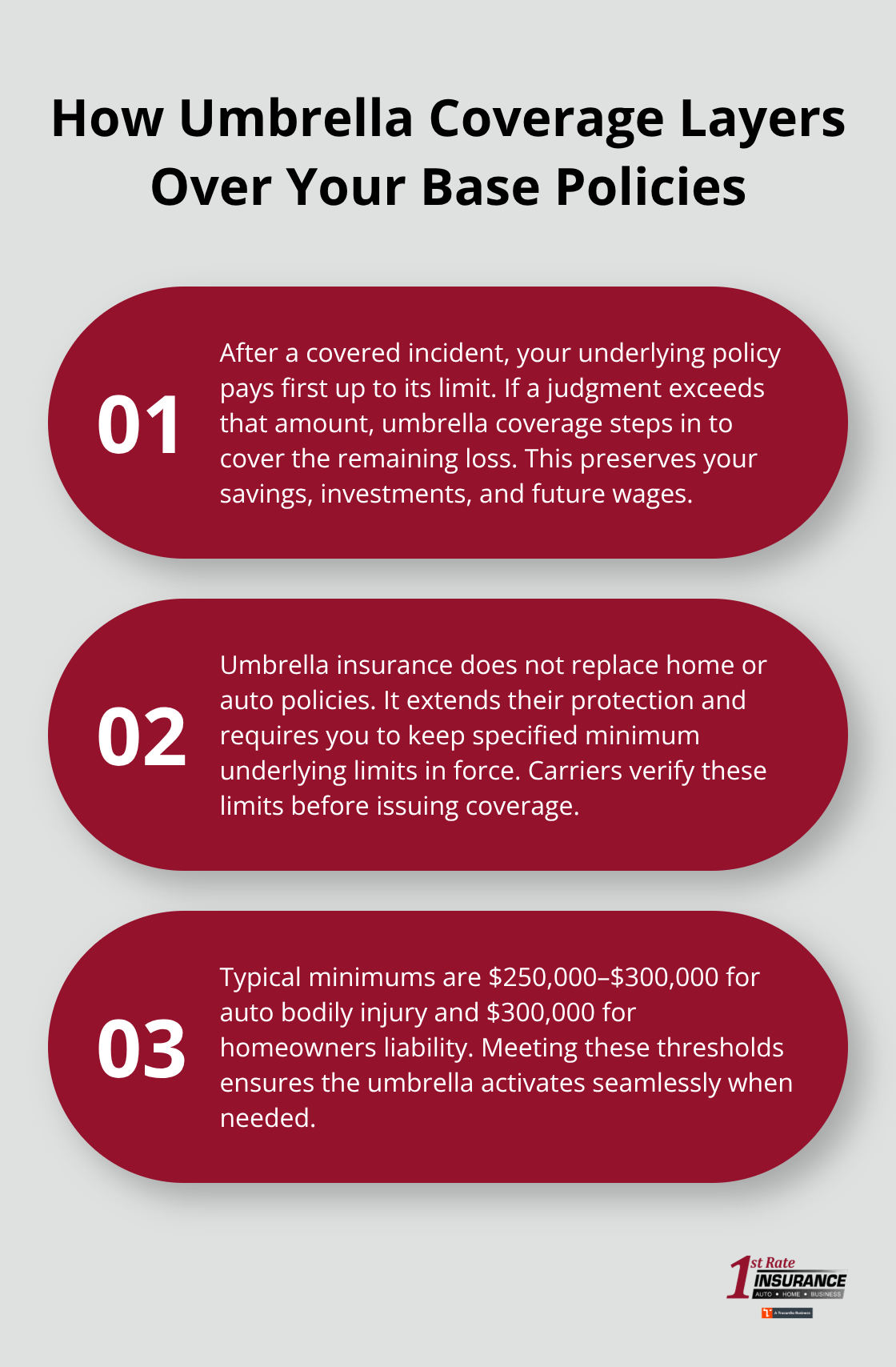
Insurance companies won’t sell you umbrella coverage if your foundation is weak.
What Triggers Your Umbrella Policy
The policy activates based on the same incidents covered by your underlying policies, meaning it responds to auto accidents, guest injuries, property damage you cause, and personal liability claims. Most umbrella policies cover incidents across all your insured properties and vehicles, providing unified protection rather than fragmented coverage across multiple policies. Your umbrella policy covers bodily injury and property damage claims that exceed your underlying limits, but it also fills gaps your base policies leave open.
Coverage That Extends Beyond Standard Policies
Personal liability claims-defamation, false imprisonment, invasion of privacy-often fall outside standard homeowners and auto policies entirely. Umbrella coverage extends into these gaps, protecting you when someone sues for non-physical harm. Rental liability also qualifies; if you rent a vacation home and cause damage, umbrella coverage applies. Medical payments coverage works similarly; if a guest is injured at your property and medical costs exceed your homeowners medical payments limit of $1,000 to $5,000, umbrella steps in. Umbrella policies typically start at $1 million in coverage and cost $150 to $300 annually for that protection, making the per-incident cost negligible compared to the financial exposure. Coverage limits expand to $2 million, $3 million, or higher depending on your assets and risk profile.
How Your Policies Coordinate in Practice
The coordination between policies follows a specific sequence that protects you but requires understanding. When a claim occurs, your underlying policy pays first up to its limit. Only after that limit exhausts does the umbrella policy activate. This means if you face a $400,000 claim and your homeowners policy covers $300,000, your umbrella pays the remaining $100,000. However, umbrella policies include self-insured retention clauses in some cases-essentially a deductible that applies to claims not covered by underlying policies. Many umbrella policies waive this retention if you maintain adequate underlying coverage, which is why carriers insist on minimum limits.
The coordination also means your umbrella policy won’t cover what your underlying policy specifically excludes. If your homeowners policy excludes business liability and someone sues you for a business-related injury on your property, umbrella won’t fill that gap. This is why reviewing your actual policy language matters before purchasing umbrella coverage. Licensed agents shop more than 20 carriers to identify which combinations of underlying and umbrella policies coordinate most effectively for your specific household, avoiding gaps that look covered but actually aren’t.
Understanding how umbrella policies coordinate with your existing coverage sets the foundation for the next critical decision: determining the right coverage limits for your family’s specific assets and lifestyle.
How Much Umbrella Coverage Do You Actually Need
Calculate Your Net Worth to Set Your Coverage Floor
The gap between what you own and what your policies cover determines your umbrella limit, not some arbitrary industry standard. Start by adding up your liquid assets-savings, investment accounts, retirement funds accessible without penalty-and your illiquid assets like home equity and vehicle value. If you own a home worth $600,000 with $200,000 in equity remaining on your mortgage, plus $150,000 in savings and $50,000 in investments, your total net worth sits around $400,000. That’s your financial target. You need umbrella coverage equal to or exceeding this amount because a judgment can attach to your wages, bank accounts, and home equity for years.
A $1 million umbrella policy costs $150 to $300 annually for families with standard risk profiles, making it extraordinarily cheap insurance against losing everything you’ve built. Families with net worth exceeding $1 million should jump to $2 million in coverage; those with $2 million or more should consider $3 million to $5 million limits. The premium difference between $1 million and $2 million coverage typically runs $100 to $150 per year, yet doubles your protection.
Match Your Lifestyle Risk to Higher Coverage Limits
Your specific exposure multiplies these baseline numbers significantly. Frequent entertaining, a swimming pool, a trampoline, or teenage drivers substantially increase claim probability. Homeowners with pools face roughly three times higher liability claims than those without, according to insurance industry data. If you host regular gatherings where alcohol is served, your exposure climbs further; liability claims involving alcohol-related incidents average higher payouts than standard guest injury cases.
A family with $500,000 in assets but no pool and minimal entertaining can operate safely with $1 million coverage, while a family with identical assets, a pool, and monthly gatherings needs $2 million minimum. Rental properties you own or manage create separate liability exposure that your primary umbrella may not cover adequately.
Understand Premium Costs Across Coverage Tiers
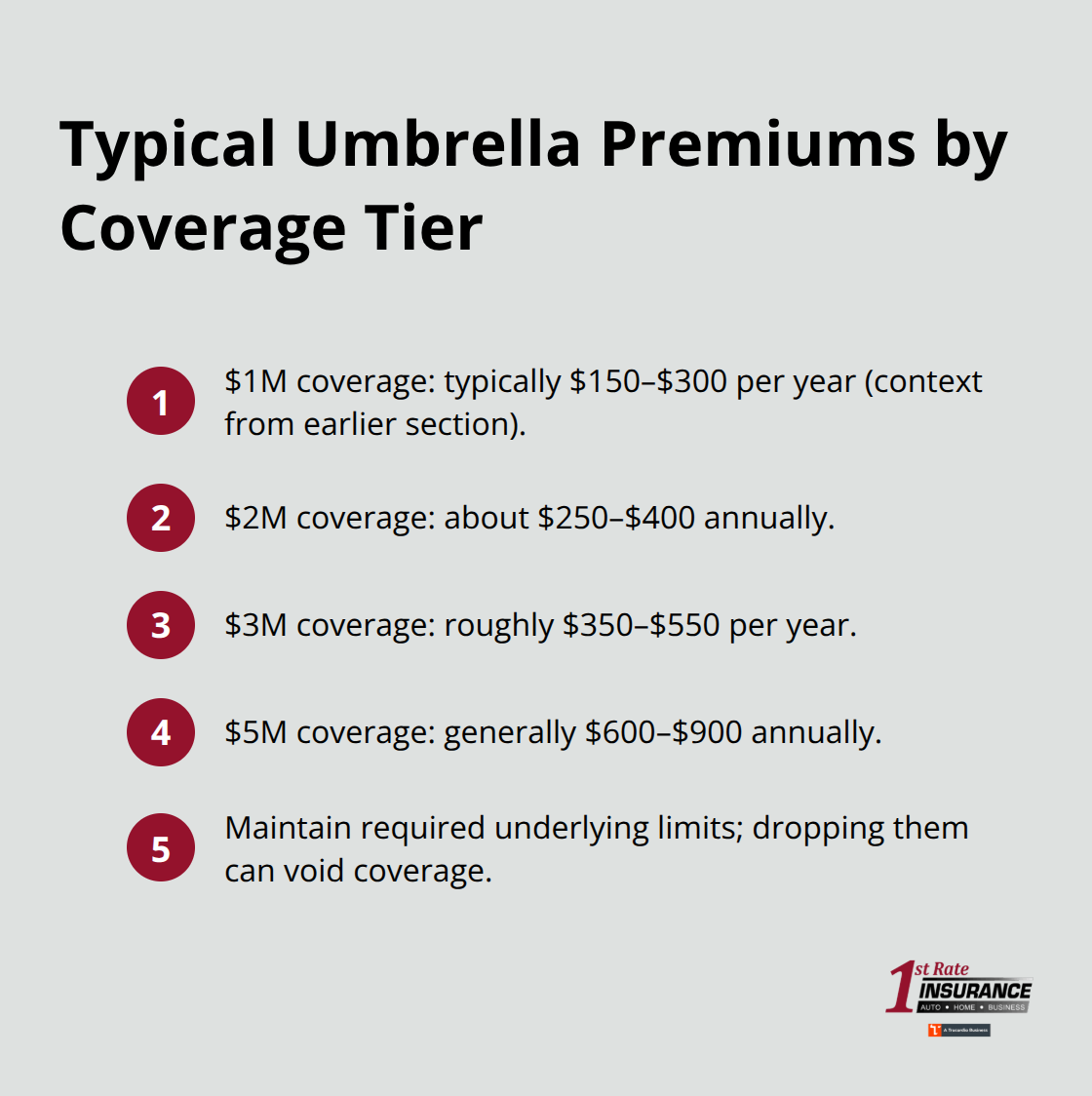
Premium costs scale predictably across coverage levels. $2 million in coverage averages $250 to $400 annually, $3 million runs $350 to $550, and $5 million reaches $600 to $900 yearly. These figures assume you maintain minimum underlying limits on home and auto policies-dropping those limits to save money defeats the entire umbrella strategy and often voids coverage when you need it most.
Licensed agents shop more than 20 carriers to match your specific household profile (your assets, your activities, and your risk factors) with appropriate coverage limits rather than applying generic recommendations. This personalized approach identifies the right balance between protection and cost for your family’s actual situation.
Final Thoughts
Umbrella coverage for families protects everything you’ve built when a single lawsuit threatens your financial security. The cost runs roughly $150 to $300 annually for $1 million in coverage, yet shields you from judgments that routinely exceed $500,000. Your standard home and auto policies leave massive gaps that umbrella protection fills affordably.
Calculate your net worth first-add your home equity, savings, and investments to determine your coverage target. If you own a pool, host frequent gatherings, or have teenage drivers, increase your limit to $2 million or higher since these activities multiply your liability exposure. Most families need $1 million to $2 million in umbrella coverage; those with higher net worth should consider $3 million or more.
Contact First Rate Insurance Plus, Inc. to receive a quote tailored to your household’s specific situation. Our licensed agents shop more than 20 carriers to find competitive pricing and umbrella policies that coordinate properly with your existing coverage. The process takes minutes, and the protection lasts for years.
Disclaimer: The information provided in this blog is for general informational purposes only and does not constitute legal, financial, or insurance advice. Coverage options, terms, and availability may vary. Please consult with a licensed professional for advice specific to your situation. Artificial intelligence may have been used to generate text and images in some blog articles.