
Rent Loss Coverage Kirkland: Safeguard Rental Income After Disruptions
A single fire, flood, or major repair can halt your rental income overnight. Property owners in Kirkland face real financial pressure when tenants can’t occupy their units during recovery.
Rent loss coverage Kirkland protects you from this gap. We at First Rate Insurance Plus, Inc. help property owners understand their options and build policies that match their actual income needs.
What Rent Loss Coverage Actually Protects
Rent loss coverage fills a specific gap that standard property insurance leaves wide open. When a covered event damages your rental property, your standard homeowners or landlord policy pays to repair the building. Rent loss coverage pays your lost rental income while repairs happen and your unit sits empty. The Washington Department of Insurance recognizes this as a distinct coverage type because the financial damage from lost rent often exceeds the cost of physical repairs. A three-month vacancy from fire or water damage can cost a Kirkland landlord thousands in foregone income, yet many policies stop at covering the building itself.
When Covered Events Force Tenants Out
Fires and floods grab headlines, but they’re not the only triggers. Major plumbing failures, electrical problems requiring unit closure, or roof damage that forces tenant relocation all qualify. Even mold remediation or foundation repairs can make a unit uninhabitable for weeks or months. According to the Insurance Information Institute, water damage and freezing cause significant property damage claims, and many of these force temporary vacancies. In Kirkland’s climate, burst pipes during cold snaps happen regularly, and the resulting repairs often take longer than property owners anticipate. Roof replacements typically run 4 to 8 weeks, during which tenants cannot safely occupy the space.
How Quickly Lost Rent Compounds
Property owners underestimate the financial toll of vacancy. A Kirkland rental unit generating 2,500 dollars monthly loses 7,500 dollars in three months of downtime. Add mortgage payments, property taxes, insurance premiums, and utilities you still must cover, and the actual loss often reaches 10,000 to 15,000 dollars for a mid-range incident. The National Association of Residential Property Managers reports that uninsured rental income loss ranks among the top financial stressors for small landlords, often forcing property sales at unfavorable terms. Without rent loss coverage, this financial burden falls entirely on you, potentially straining cash flow or forcing you to borrow against other assets.
Coverage Limits Match Your Recovery Timeline
Coverage limits typically range from 12 to 24 months of lost rent, giving you real protection against extended recovery periods. A single incident can mean 2 to 4 months without rental income while you’re still paying property taxes, mortgage, and maintenance costs. The coverage activates only when a covered peril forces the tenant out, not when tenants simply leave or fail to pay. Understanding these limits matters because they determine how much financial protection you actually have when disruption strikes.
Washington Rent Loss Coverage Types Explained
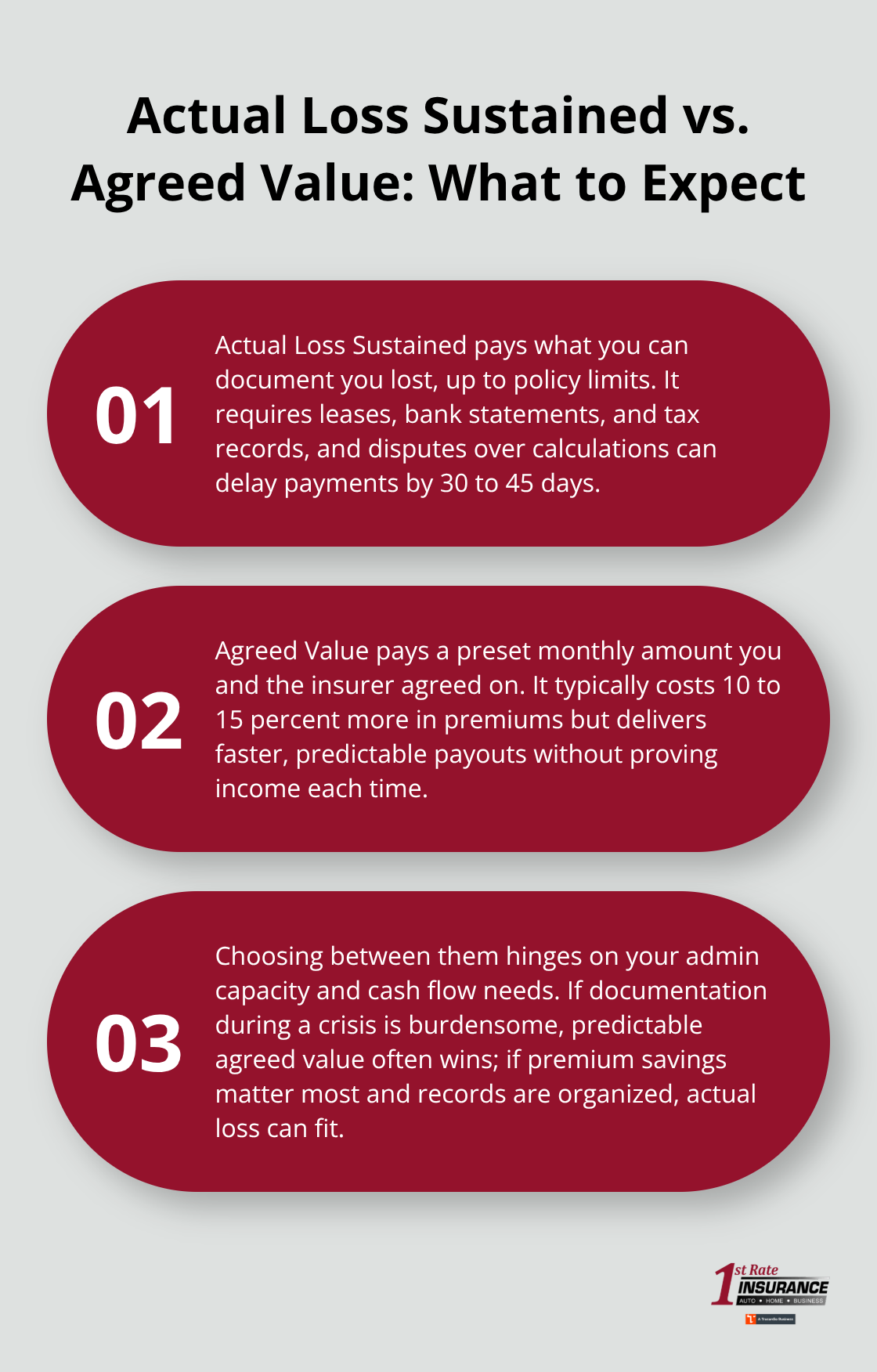
Washington insurers offer two fundamentally different approaches to rent loss coverage, and the choice between them shapes your financial protection. Actual loss sustained coverage pays whatever rent you actually lost, up to your policy limit, but requires detailed documentation of your lost income. You submit lease agreements, bank statements showing deposits, and tax returns that prove your rental income history. The insurer then calculates your actual daily loss and reimburses that amount for the period your unit remained unoccupied. Agreed value coverage works differently: you and your insurer settle on a monthly rent amount when you purchase the policy, and that’s what you receive if a covered event occurs, regardless of what you actually charged tenants. A Kirkland landlord renting a unit for 2,400 dollars monthly would receive 2,400 dollars per month of covered vacancy with agreed value coverage, even if market rates had climbed to 2,800 dollars. The trade-off matters significantly. Actual loss sustained typically costs less in premiums because insurers pay only proven losses, but you shoulder the burden of collecting documentation during an already stressful recovery period. Agreed value costs more upfront but eliminates disputes and provides immediate, predictable payouts without requiring you to prove income amounts.
Agreed Value Coverage Removes Uncertainty When It Counts Most
Agreed value coverage wins for most Kirkland rental property owners because it removes uncertainty when you need certainty most. During a fire or major water damage, your focus should land on repairs and tenant communication, not searching through financial records to prove what you earned. Insurance Information Institute data shows that claim disputes over actual loss calculations delay payments by an average of 30 to 45 days, extending your financial strain precisely when cash flow matters most. The premium difference typically runs 10 to 15 percent higher for agreed value, but that cost vanishes compared to the administrative headache and payment delays of actual loss sustained claims. Additionally, if your rental income has grown since you purchased the policy, actual loss sustained limits you to historical amounts unless you update documentation annually, while agreed value lets you adjust your coverage limit whenever your rent increases.
Named Peril Versus All-Risk Protection
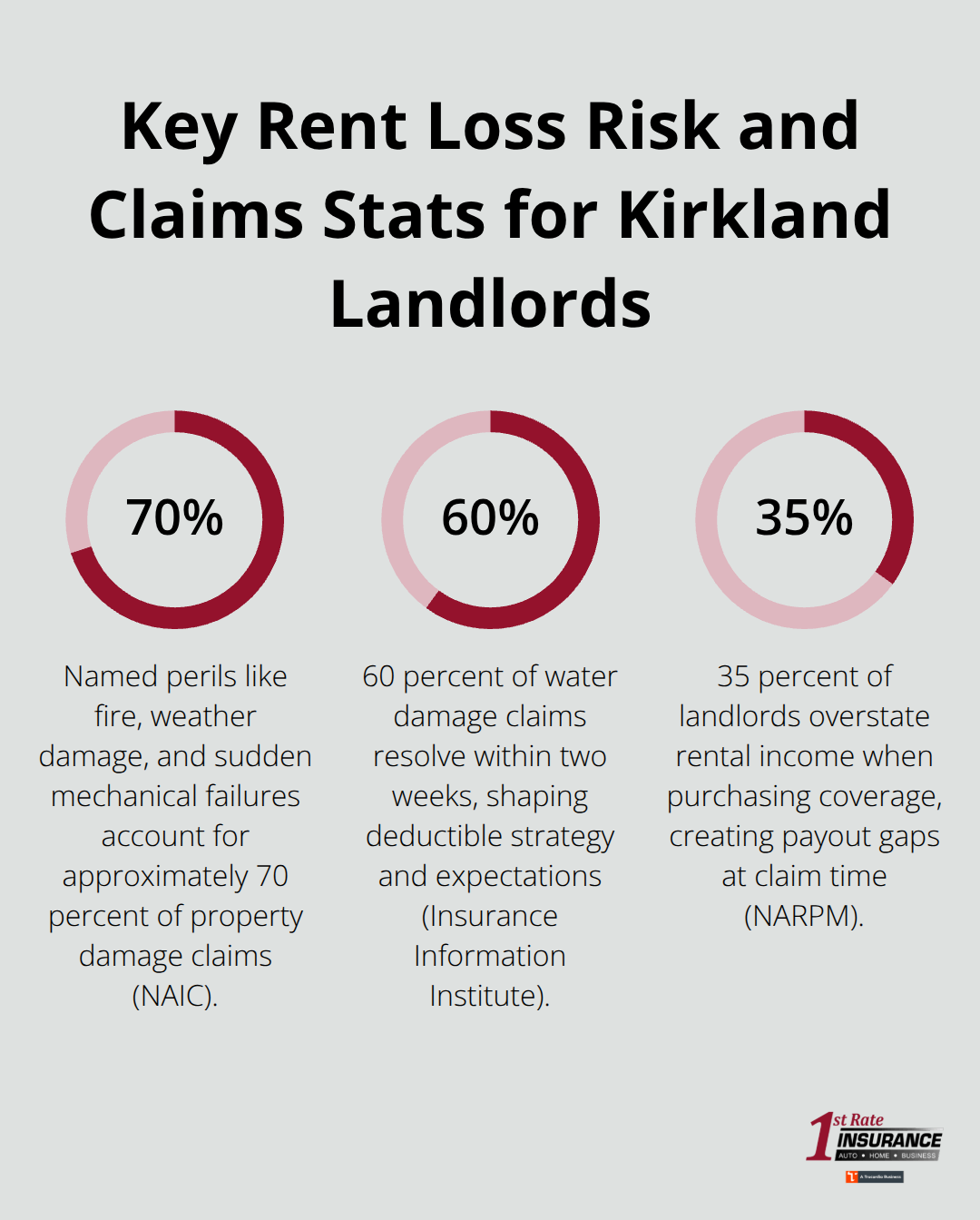
Most Washington rent loss policies operate on a named peril basis, meaning they cover only specific events: fire, wind, hail, theft, vandalism, and similar explicitly listed perils. A burst pipe from freezing qualifies, but foundation settling or code violations that force tenant evacuation typically do not. All-risk rent loss coverage exists but remains rare in Washington and commands substantially higher premiums because insurers accept broader liability. For Kirkland property owners, named peril coverage addresses the genuine risks: fire, weather damage, and sudden mechanical failures that force vacancies. These perils cause approximately 70 percent of property damage claims according to the National Association of Insurance Commissioners, so named peril policies cover what actually happens most often. All-risk coverage appeals only to owners with unusual properties or high-value units where the extra premium cost justifies expanded protection.
How Coverage Limits Align With Your Recovery Timeline
Coverage limits typically range from 12 to 24 months of lost rent, giving you real protection against extended recovery periods. A single incident can mean 2 to 4 months without rental income while you’re still paying property taxes, mortgage, and maintenance costs. The coverage activates only when a covered peril forces the tenant out, not when tenants simply leave or fail to pay. Understanding these limits matters because they determine how much financial protection you actually have when disruption strikes. Your next step involves assessing your specific rental income and the risks your property faces, which determines the right coverage amount and type for your situation.
How to Choose the Right Rent Loss Coverage for Your Property
Match Coverage to Your Documented Rental Income
Start with your actual monthly rent, not what you think the market will bear next year. Pull your last two years of lease agreements and bank deposit records showing what tenants actually paid. If you rent a Kirkland unit for 2,400 dollars monthly, that 2,400 dollars becomes your baseline for agreed value coverage, not an inflated number you hope to charge eventually. Many property owners overstate their rental income when selecting coverage limits, then face denial or underpayment when claims arrive because their documentation doesn’t support the higher amount. The National Association of Residential Property Managers found that 35 percent of landlords overstate their rental income by 15 to 25 percent when purchasing coverage, creating a gap between their policy limit and their actual provable losses.
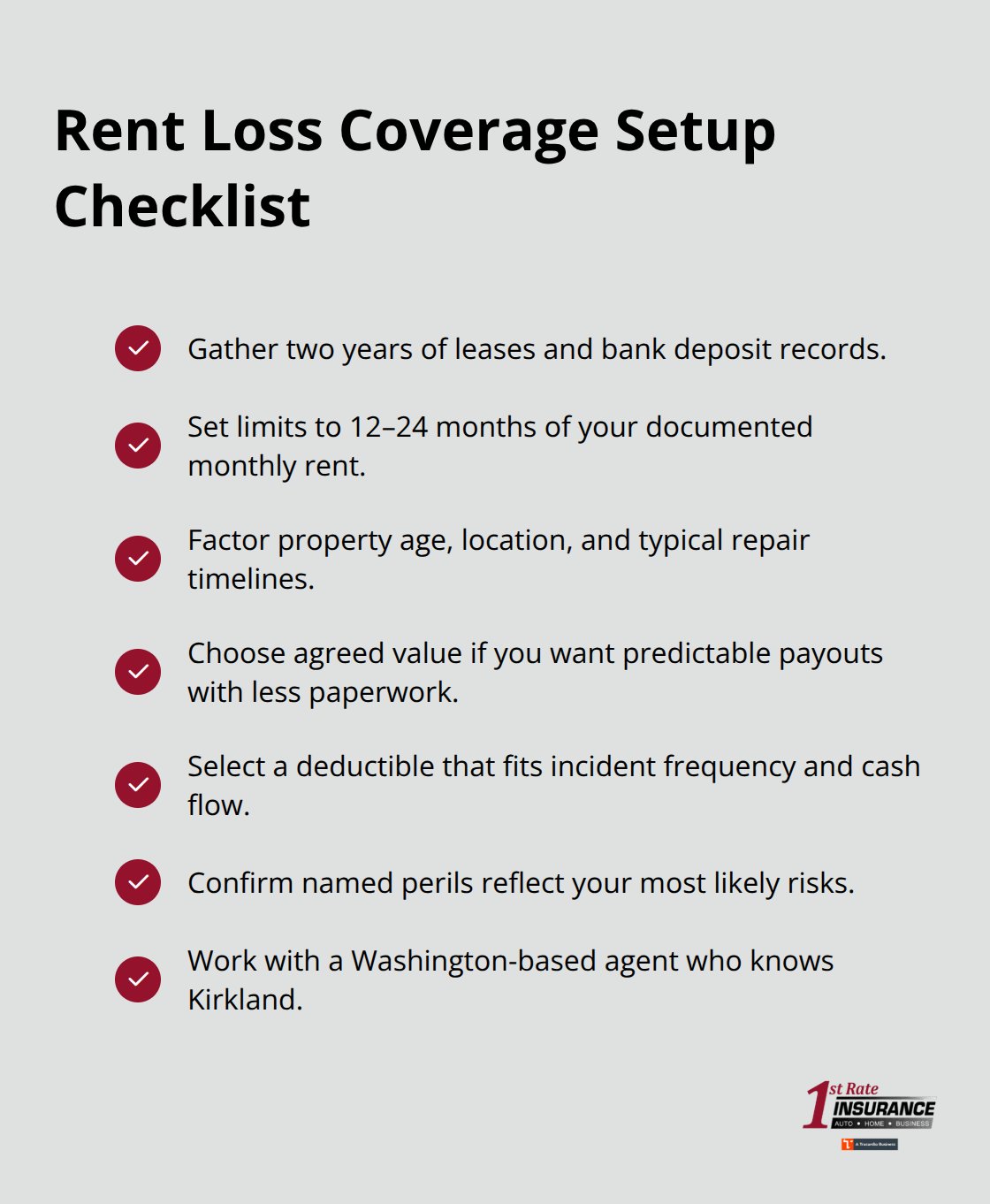
Your coverage limit should match 12 to 24 months of your documented monthly rent, which means a unit generating 2,400 dollars monthly warrants a limit of 28,800 to 57,600 dollars in annual rent loss protection. Account for your specific risk profile next. Rent loss coverage generally applies when your rental property sustains damage from a “named peril” listed in your insurance policy, making it temporarily uninhabitable. Properties in flood-prone areas near Kirkland streams need longer coverage periods because water damage repairs extend beyond typical fire recovery timelines, often requiring 8 to 12 weeks. Older buildings with outdated electrical or plumbing systems face higher incident frequency, justifying the upper range of coverage limits. A 1970s rental property with original wiring should carry 24-month coverage; a 2015 unit with modern systems can operate effectively with 12-month limits.
Your mortgage balance and monthly carrying costs matter too. If your mortgage, taxes, and insurance total 1,800 dollars monthly but your rent is only 2,400 dollars, your actual financial loss during vacancy reaches 1,800 dollars daily, not 80 dollars. Coverage must account for this reality because rent loss policies reimburse lost rent only, not your other carrying costs. You’ll absorb those expenses regardless of coverage limits, so your cash flow calculations should reflect this hard truth when deciding how much protection you actually need.
Select Deductibles That Match Your Risk Tolerance
Rent loss coverage typically offers deductibles of 7, 14, or 30 days, meaning you absorb that many days of lost rent before coverage kicks in. A 14-day deductible on a 2,400-dollar monthly unit means you pay 1,120 dollars out of pocket before the insurer contributes anything. This matters because most minor incidents resolve within 7 to 14 days; your plumbing repair completes, water damage dries and restoration finishes, and your tenant moves back in before your coverage even activates. The Insurance Information Institute reports that 60 percent of water damage claims resolve within two weeks, making a 14-day deductible ineffective for typical incidents.
Try a 7-day deductible if your property sits in a high-risk zone or has aging systems prone to frequent disruptions. A newer building or property with strong preventive maintenance can safely accept a 14-day deductible and lower your premium by approximately 10 to 12 percent. Avoid 30-day deductibles unless you’re willing to self-insure the first month of any vacancy, which defeats the purpose of rent loss coverage for most Kirkland landlords. Pairing your deductible choice with your coverage limit creates your actual protection. A 24-month policy with a 30-day deductible means you’re only truly protected for 23 months, and only after absorbing a full month of losses yourself.
Work With a Local Agent to Customize Your Policy
Generic online insurance quotes cannot account for Kirkland’s flood patterns, the age of your specific neighborhood’s infrastructure, or local building code requirements that affect repair timelines. Your property’s distance from the Sammamish River, its elevation relative to local drainage patterns, and whether it sits in a designated flood zone all influence your risk profile and the coverage you genuinely need. An agent familiar with Kirkland properties can identify that a unit built in 1985 in the downtown corridor faces different risks than an identical structure built the same year five miles north.
Local agents also know which carriers in Washington actually pay rent loss claims promptly versus those that dispute calculations for months. Your coverage type choice depends partly on which carriers you access through an agent, since some insurers offer agreed value rent loss while others limit you to actual loss sustained. An experienced local agent negotiates your deductible, coverage limit, and policy type together as a cohesive package rather than treating each as an isolated selection. We at First Rate Insurance Plus, Inc. shop more than 20 carriers to find the right fit for your rental property’s specific needs and risk profile.
Final Thoughts
Rent loss coverage Kirkland protects your rental income when property damage forces tenants out, but only if you select the right coverage type and limits for your specific situation. The financial impact of vacancy extends far beyond the lost rent itself-your mortgage, taxes, insurance, and maintenance costs continue regardless of whether tenants occupy your unit. A three-month disruption from fire or water damage can drain 10,000 to 15,000 dollars from your cash flow, making adequate coverage a financial necessity rather than an optional add-on.
Your protection depends on three concrete decisions: match your coverage limit to your documented monthly rent multiplied by 12 to 24 months (accounting for your property’s age, location, and repair timeline risks), choose agreed value coverage if you want predictable payouts without documentation disputes, and select a deductible that reflects your actual risk tolerance. Most Kirkland properties benefit from 7-day deductibles since typical repairs complete within two weeks anyway. Start by gathering your lease agreements and two years of bank statements showing actual rental deposits, as these documents prove your income to insurers and prevent the 35 percent overstatement problem that creates coverage gaps when claims arrive.
We at First Rate Insurance Plus, Inc. shop more than 20 carriers to find rent loss coverage that matches your rental property’s actual needs and risk profile. Contact First Rate Insurance Plus for a personalized quote that protects your rental income against the disruptions that actually happen in Kirkland.
Disclaimer: The information provided in this blog is for general informational purposes only and does not constitute legal, financial, or insurance advice. Coverage options, terms, and availability may vary. Please consult with a licensed professional for advice specific to your situation. Artificial intelligence may have been used to generate text and images in some blog articles.

