

Rent Protection for Landlords: Keeping Income Safe After Losses
Rental income is your business, and losing it can derail your financial plans fast. Whether a tenant stops paying or a fire forces you to close the property temporarily, the gap between disaster and recovery can be brutal.
At First Rate Insurance Plus, Inc., we know that rent protection for landlords isn’t optional-it’s the difference between weathering a crisis and facing serious cash flow problems. This guide walks you through what coverage actually protects you and how to pick the right policy for your situation.
What Rent Protection Actually Covers
Rent protection insurance fills a specific gap that standard landlord policies ignore: loss of rental income when you cannot collect rent or the property becomes uninhabitable. When a tenant stops paying, you still face mortgage payments, property taxes, maintenance costs, and utilities piling up. A fire or severe weather damage can force you to vacate tenants temporarily, cutting off income while repairs happen. Rent protection covers these lost monthly rental payments during the claim period, typically starting after a waiting period of 14 to 30 days. The waiting period exists because most landlords have some cash reserves, and insurers use it to reduce claims volume. Coverage amounts usually range from 6 to 12 months of lost rent, though you select the specific limit when you purchase the policy. The policy reimburses you for the actual rent you would have collected, up to your chosen limit, once the claim qualifies.
Tenant Default Claims Require Different Documentation Than Property Damage Claims
When a tenant stops paying, you must follow your state’s eviction process before the insurance company will consider your claim. This matters because insurers will not pay for rent while you remain legally required to provide habitable housing or while you are in the middle of eviction proceedings. You must document the eviction timeline, proof that rent went unpaid, and evidence that you attempted collection. The waiting period typically starts after the eviction is complete and the unit sits vacant. For property damage situations, the process moves faster. If a fire damages your rental property, the insurer investigates the damage, confirms the property is uninhabitable, and begins the waiting period. Once the waiting period expires, you start receiving monthly rent payments for up to your policy limit. Claims are paid monthly or in a lump sum (depending on your policy terms), with most insurers processing payments within 30 days of approval. You will need documentation showing the property damage, repair estimates, and projected timeline to occupancy.
Deductibles and Coverage Limits Determine Your Real Protection
Most rent protection policies carry deductibles ranging from $500 to $2,500 per claim, which reduces the insurer’s payout by that amount. A higher deductible lowers your premium but means you absorb more loss upfront. Coverage limits typically cap at 6 to 12 months of rent, so if your monthly rent is $2,000 and you choose a 9-month limit, the maximum payout is $18,000. The waiting period is critical because it determines when payments begin. A 30-day waiting period means you eat the first month of lost income yourself, while a 14-day waiting period reduces your out-of-pocket exposure. Some policies exclude certain scenarios entirely, like rent loss from tenant disputes you could have prevented with stronger lease language or from voluntary property closures. The exclusions matter more than the coverage summary because that is where real limitations hide.
What Happens Next: Evaluating Your Coverage Needs
Now that you understand how rent protection works and what shapes your actual payout, the next step is identifying which policy features align with your rental business. Different landlords face different risks-a single-family home in a stable neighborhood has different exposure than a multi-unit property in an area prone to severe weather. Your choice of waiting period, deductible, and coverage limit should reflect both your cash reserves and the income you cannot afford to lose.
When Rent Loss Becomes Real
Evictions Drain Cash Flow Faster Than You Expect
Tenant evictions create the most straightforward rent protection claims, yet many landlords underestimate how quickly they drain cash flow. An eviction in Washington takes 20 to 40 days on average, depending on court schedules and whether the tenant contests the case. During this period, you receive no rent while still covering the mortgage, property taxes, insurance, and maintenance. Your lender won’t pause your mortgage payment, and property taxes remain due regardless of occupancy status.
Once the eviction completes, vacancy periods stretch longer than most landlords anticipate. The National Multifamily Housing Council reports average vacancy periods, with some properties sitting empty for extended periods in slower rental markets. If your monthly rent is $1,800 and the unit sits vacant for 10 weeks, you lose roughly $4,150 in income before a new tenant moves in and pays their first month’s rent.
How Rent Protection Bridges the Income Gap
Rent protection insurance covers this lost income once the waiting period expires, which typically means payments start around day 30 to 45 after eviction completion. The claim payout doesn’t depend on how quickly you can access savings or secure a construction loan. Most insurers process these claims within 30 days of approval, meaning you start receiving replacement income while the property remains vacant.
Property Damage Creates Longer Income Disruptions
Property damage scenarios move faster and often hit harder financially. A kitchen fire that damages a rental unit requires 6 to 12 weeks to repair, depending on structural damage and contractor availability. During repairs, the unit generates zero income while you still face all ownership costs. Weather damage from severe storms or flooding creates similar situations, with water-damaged units requiring 8 to 16 weeks of remediation and rebuilding.
Natural disasters like earthquakes or major storms force temporary uninhabitability for months, especially if city permits delay reconstruction. Rent protection covers these income gaps by reimbursing your lost monthly rent during the repair period, up to your chosen coverage limit. If you carry a 9-month limit and repairs take 12 weeks, you receive approximately three months of rent payments.
What Separates Prepared Landlords From Those Caught Off Guard
The landlords who weather these crises without financial strain share one trait: they anticipated the income loss before it happened. They calculated their monthly ownership costs, identified how long they could absorb lost rent from reserves, and purchased coverage that filled the gap. The ones who struggle scramble to cover mortgage payments and property taxes while waiting for repairs to complete or new tenants to arrive.
Understanding which scenarios hit your specific rental business hardest shapes the coverage you actually need. A single-family home in a stable neighborhood faces different risks than a multi-unit property in an area prone to severe weather or economic downturns. Your next step involves identifying which protection features align with your rental operation and financial position.
Which Policy Details Actually Protect Your Income
The gap between what a rent protection policy claims to cover and what it actually pays you comes down to three specific choices: your waiting period, your coverage limit, and your deductible. Most landlords focus on the premium price and miss the details that determine whether you receive meaningful income replacement or just a policy that sounds good on paper. A 30-day waiting period paired with a $2,500 deductible and a 6-month coverage limit tells a completely different financial story than a 14-day waiting period with a $500 deductible and a 12-month limit, even if both policies cost roughly the same amount.
The Waiting Period Determines Your Out-of-Pocket Loss
The waiting period is where most landlords get hurt. During an eviction, you lose rent immediately, but your insurance doesn’t start paying until the waiting period ends. A 30-day waiting period means you absorb the first month entirely-roughly $1,500 to $3,000 for most single-family rentals-before any reimbursement arrives. A 14-day waiting period cuts that out-of-pocket loss roughly in half, which matters enormously when you’re already covering mortgage payments and property taxes during vacancy.
Your cash position determines which waiting period works for you. If you have liquid reserves of $5,000 or more, a 30-day waiting period works fine. If your cash position is tighter, the 14-day option protects you from financial strain that could force you into emergency borrowing.
Coverage Limits Must Match Your Repair Timeline
Coverage limits determine your maximum payout, and this number should match your actual monthly rent multiplied by how long you realistically expect income loss. If your monthly rent is $2,000 and property damage typically takes 12 weeks to repair, you need roughly $6,000 in coverage to stay whole (three months of rent). Most fire and weather damage claims resolve in 8 to 16 weeks, so a 6-month limit covers you for longer scenarios without unnecessary overinsurance.
Many landlords buy 6-month limits thinking they’re being conservative, but that assumes damage takes half a year to repair. The reality is that most property damage claims resolve much faster, making a 6-month limit sufficient for nearly all scenarios.
Deductibles Shape Your Real Claim Payout
Deductibles range from $500 to $2,500 per claim, and the math here is straightforward: higher deductibles mean lower premiums, but you absorb more loss personally. If you file a claim for $8,000 in lost rent with a $2,500 deductible, the insurer pays $5,500. With a $500 deductible, you receive $7,500.
Over a ten-year policy period, you might file one or two claims, so the deductible difference matters less than the waiting period and coverage limit do. However, when a claim does occur, that deductible hits your cash flow immediately.
Legal Expense Coverage Addresses Hidden Costs
Beyond these three core features, additional protections address scenarios where rent loss intersects with legal costs. Legal expense coverage pays attorney fees if you need to pursue eviction, recover unpaid rent through small claims or civil court, or defend against tenant lawsuits.
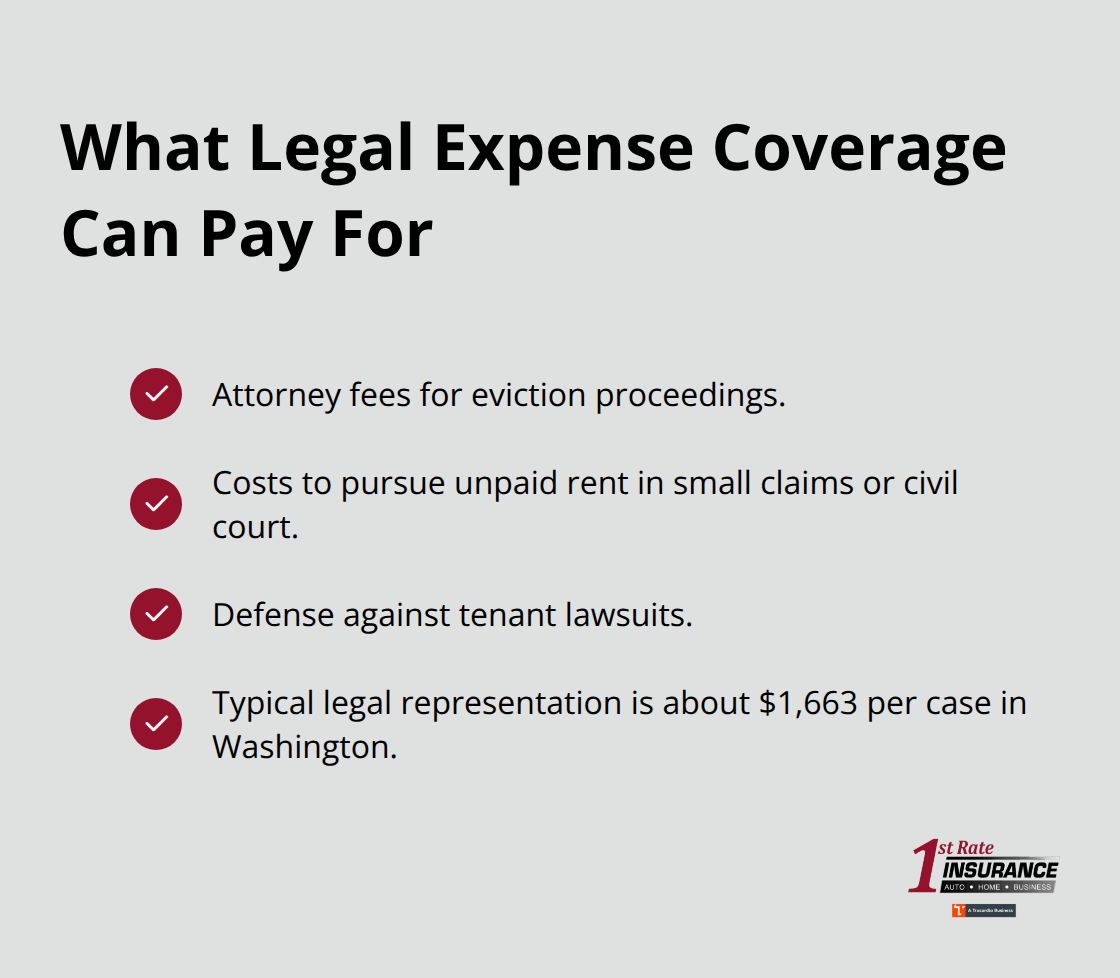
Legal representation costs about $1,663 per case in Washington.
If your rent protection policy includes legal expense coverage with a $5,000 or $10,000 annual limit, those attorney fees come directly from the policy rather than your pocket. Some policies also cover loss of rent during disputes about lease violations or security deposit claims, which protects you when tenants withhold rent over maintenance issues that don’t actually render the property uninhabitable.
Comparing Strong Coverage Against Weak Policies
The strongest policies combine a 14-day waiting period, a 12-month coverage limit, a $500 deductible, and legal expense coverage up to $10,000. This combination costs more than bare-bones coverage, but it covers nearly every realistic income loss scenario without forcing you to choose between paying your mortgage and pursuing legitimate claims. Weaker policies use 30-day waiting periods, 6-month limits, and $2,500 deductibles to keep premiums artificially low, leaving you exposed during the exact moments when you need protection most. Your decision should reflect your specific rental operation and financial reserves, not the lowest available premium.
Final Thoughts
Rent protection for landlords fills a gap that standard policies ignore, and that gap can destroy your cash flow when income stops. Without it, a tenant eviction or property damage claim forces you to cover mortgage payments, property taxes, and maintenance costs from your personal reserves while waiting weeks or months for repairs or new tenants to arrive. The landlords who weather these crises without financial strain anticipated the income loss and purchased coverage that matched their situation.
Evaluating policies requires looking past the premium price and examining the three features that determine your real protection: the waiting period, coverage limit, and deductible. A 14-day waiting period cuts your out-of-pocket loss roughly in half compared to a 30-day waiting period, which matters enormously when cash flow tightens. Your coverage limit should match your monthly rent multiplied by how long repairs typically take in your area, and additional protections like legal expense coverage address the hidden costs of evictions that can reach $1,663 or more per case.
Calculate your monthly ownership costs and identify how long you could absorb lost rent from your reserves. If that gap extends beyond a few weeks, rent protection becomes essential. First Rate Insurance Plus, Inc. works with landlords across Washington to build policies that fill those gaps without unnecessary overinsurance.
Disclaimer: The information provided in this blog is for general informational purposes only and does not constitute legal, financial, or insurance advice. Coverage options, terms, and availability may vary. Please consult with a licensed professional for advice specific to your situation. Artificial intelligence may have been used to generate text and images in some blog articles.
