

Bellevue Condo Insurance: Affordable Coverage For Your City Home
Condo living in Bellevue offers urban convenience, but your homeowners insurance likely won’t cut it. Standard policies leave critical gaps that can cost you thousands when something goes wrong.
At First Rate Insurance Plus, Inc., we help Bellevue condo owners find coverage that actually protects their investment. This guide walks you through what Bellevue condo insurance in WA should include, how to find affordable rates, and why local expertise matters for your specific situation.
What Your Condo Insurance Actually Needs to Cover
Understanding the Split Ownership Problem
Condo insurance differs fundamentally from standard homeowners policies because you own the interior of your unit while the building’s structure, roof, and common areas belong to the HOA. This split ownership creates confusion about what you’re responsible for insuring. Your condo association’s master policy covers the building’s exterior and common spaces, but it leaves your personal belongings, interior walls, and liability exposure completely unprotected.
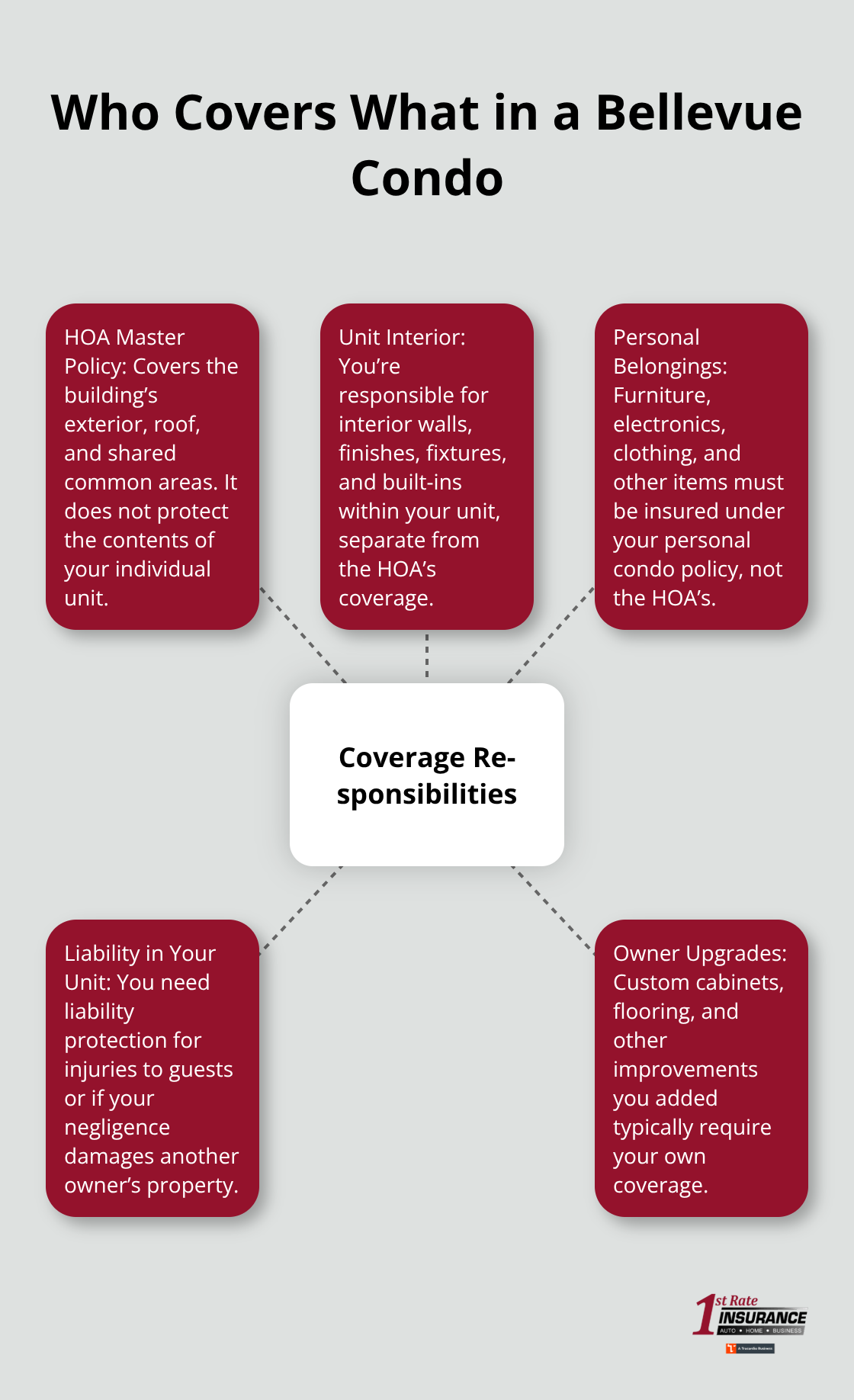
Many Bellevue condo owners assume their HOA coverage extends to their unit, then face devastating out-of-pocket costs when water damage, theft, or a visitor’s injury occurs. Condo owners without proper individual coverage face an average financial loss of $15,000 to $40,000 per incident, depending on the claim type.
Personal Property and Interior Improvements
Your condo policy must cover your personal property, interior improvements you’ve made, and liability protection for accidents within your unit. Personal property coverage reimburses you for furniture, electronics, clothing, and other belongings if fire, theft, or covered perils damage them-typically up to 50 to 75 percent of your policy limit.
Interior improvements coverage pays for upgrades like custom cabinets, flooring, or paint that you’ve added beyond the unit’s original condition, since the HOA policy won’t cover these. A condo insurance policy usually covers interior structures like drywall and lighting fixtures, depending on your state and association bylaws. This distinction matters significantly because many owners invest thousands in upgrades, only to discover they have no protection when damage occurs.
Liability Protection for Your Unit
Liability protection defends you if someone is injured in your unit or your negligence damages another owner’s property. Most policies offer $100,000 to $300,000 in liability limits, though you can increase this based on your situation and assets. A single lawsuit from a visitor’s injury can exceed standard limits quickly, making adequate liability coverage essential for your financial security.
Assessment and Loss Coverage
Many Bellevue condo owners overlook assessment coverage, which protects you if the HOA levies a special assessment after major damage to the building-a real risk in older condos. Loss assessment coverage typically covers your share of the HOA’s deductible if a covered loss affects the building structure. Without these components in place, you expose yourself to unexpected bills that can reach tens of thousands of dollars.
Finding the Right Coverage for Your Situation
The specific coverage limits and options you need depend on your unit’s value, your personal property, and the condition of your building. Comparing quotes from multiple carriers reveals significant price differences for identical coverage-some policies cost 30 to 50 percent more than others for the same protection. Local agents who understand Bellevue’s condo market can identify which carriers offer the best rates for your specific needs and help you avoid common coverage mistakes that leave owners unprotected.
Getting Real Quotes That Actually Save You Money
Compare Identical Coverage Across Multiple Carriers
Comparing condo insurance quotes in Bellevue requires more than collecting three numbers and selecting the lowest price. Price variations for identical coverage reach 30 to 50 percent across carriers, which means your first quote could cost thousands more annually than your fifth. When you request quotes, provide identical coverage limits, deductibles, and personal property amounts to each insurer so you compare apples to apples. Most carriers offer online quote tools, but these often underestimate your actual coverage needs because they fail to account for condo-specific factors like your HOA’s deductible responsibilities or interior improvements you’ve made.
Request quotes that specifically include loss assessment coverage, which can help condo owners pay their share of expenses if the condo association’s insurance limits can’t cover certain bills. This coverage frequently gets omitted from online quotes, leaving you exposed to unexpected bills. After collecting quotes, examine the declarations page for each policy, not just the premium. The declarations page shows your actual coverage limits, deductibles, and any exclusions that online systems might have missed.
Unlock Discounts That Reduce Your Premium
Discounts represent major savings opportunities that most owners overlook. Bundling your condo policy with auto insurance typically saves 15 to 25 percent on your condo premium alone, according to data from major insurers. Installing deadbolts, smoke detectors, and fire extinguishers qualifies you for safety discounts ranging from 5 to 10 percent. Some carriers reward condo owners who pay their full annual premium upfront with discounts of 3 to 8 percent.
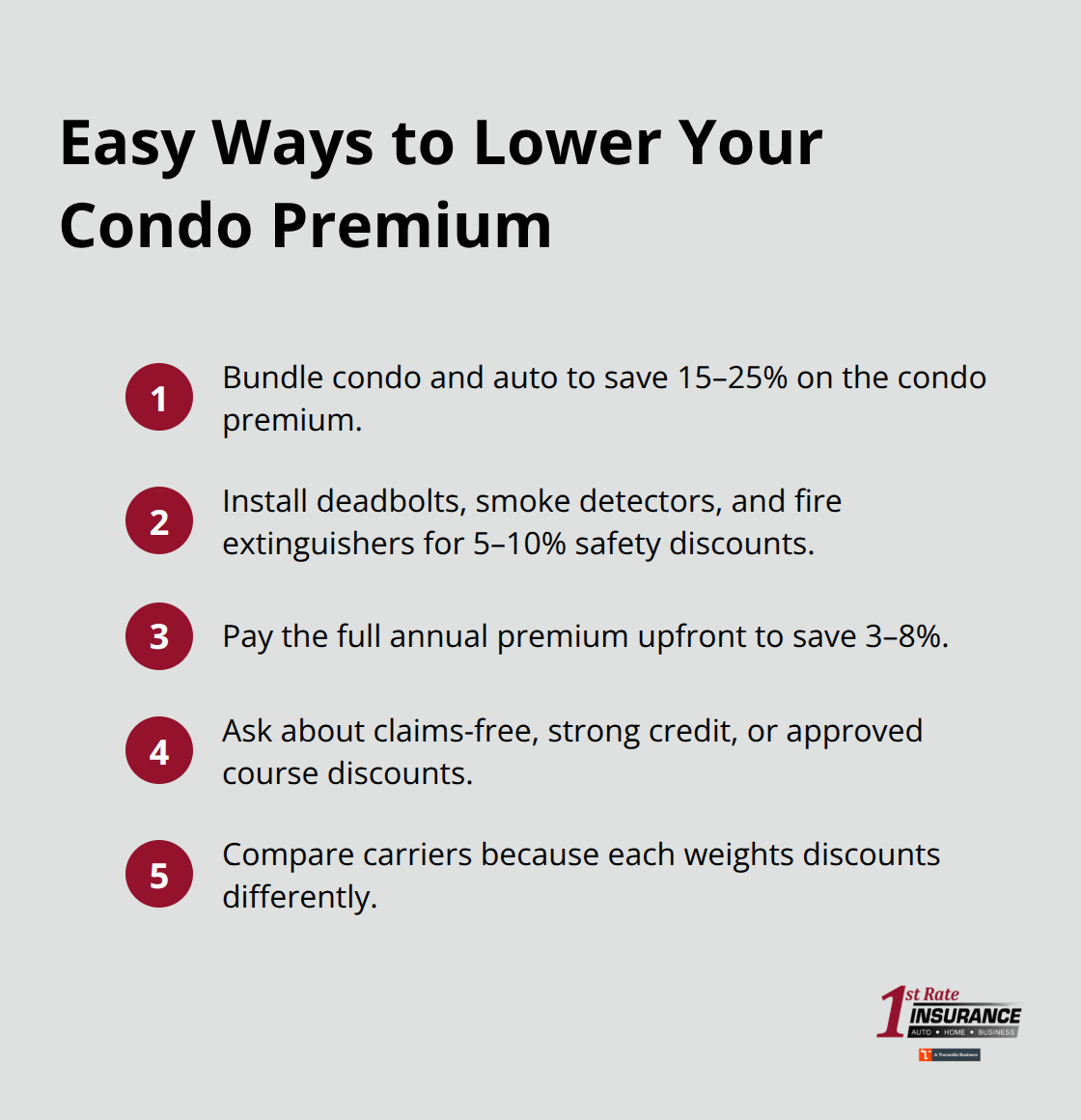
Ask each carrier about discounts for remaining claims-free for three or more years, completing defensive driving courses, or maintaining high credit scores, as these discounts vary significantly between insurers. Each carrier weights these discounts differently, so the same discount structure produces different final premiums across companies.
Work with Local Agents to Navigate Carrier Appetite
Local agents who specialize in Bellevue condo insurance understand which carriers price aggressively for your specific building and neighborhood, saving you hours of research. Agents access carrier appetite information that shows which insurers actively want condo business in your area versus those charging premium rates. Agents also catch coverage gaps that online quote systems create. For example, if your building was constructed before 1980, some carriers charge higher premiums or exclude coverage for certain perils, but experienced local agents know which insurers still offer standard rates for older buildings.
At First Rate Insurance Plus, Inc., our licensed agents shop more than 20 carriers to find options other brokers miss, ensuring you see competitive pricing from insurers who view Bellevue condos favorably.
Coordinate Your Policy with HOA Coverage
Your HOA should provide documentation about the master policy, including what the building’s coverage includes and what the association’s deductible is, because this directly affects your policy requirements. Many owners skip this step and end up with overlapping coverage they don’t need or gaps in protection they do. A local agent reviews this documentation and ensures your individual policy coordinates properly with HOA coverage, eliminating redundant protection while filling critical gaps.
Time Your Shopping for Better Rates
Rates change seasonally, and shopping during slower periods when carriers compete more aggressively yields better pricing than shopping during peak season. Most carriers allow you to lock in rates for 60 days while you decide, giving you time to collect multiple quotes without pressure. Once you’ve narrowed your options and secured competitive pricing, the next step involves understanding which specific coverages actually protect your condo investment and which ones you can safely skip.
Coverage That Actually Protects Your Condo
Liability Protection Shields Your Assets
Liability coverage sits at the foundation of condo protection because a single injury lawsuit can obliterate your personal assets. Most condo policies start at $100,000 in liability limits, but this amount offers minimal protection if someone suffers a serious injury in your unit. A guest who slips on your kitchen floor and requires surgery could generate medical bills exceeding $50,000 before legal fees enter the picture. Increasing your liability limit to $300,000 costs only 10 to 15 percent more annually than the baseline $100,000 limit, yet it covers substantially more catastrophic scenarios.
If you own significant assets, pairing your condo policy with an umbrella policy adds $1 million in additional liability protection for roughly $150 to $300 per year. This combination shields your home, investments, and future earnings from judgment claims that would otherwise devastate your financial security.
Personal Property Coverage Requires Accurate Inventory
Personal property coverage protects the belongings inside your unit, but the coverage limit you select determines your actual reimbursement when loss occurs. Most condo owners choose limits between $15,000 and $50,000, yet the average household contains $40,000 to $60,000 worth of possessions according to insurance industry data. Underestimating your personal property value means accepting partial reimbursement for total loss scenarios.
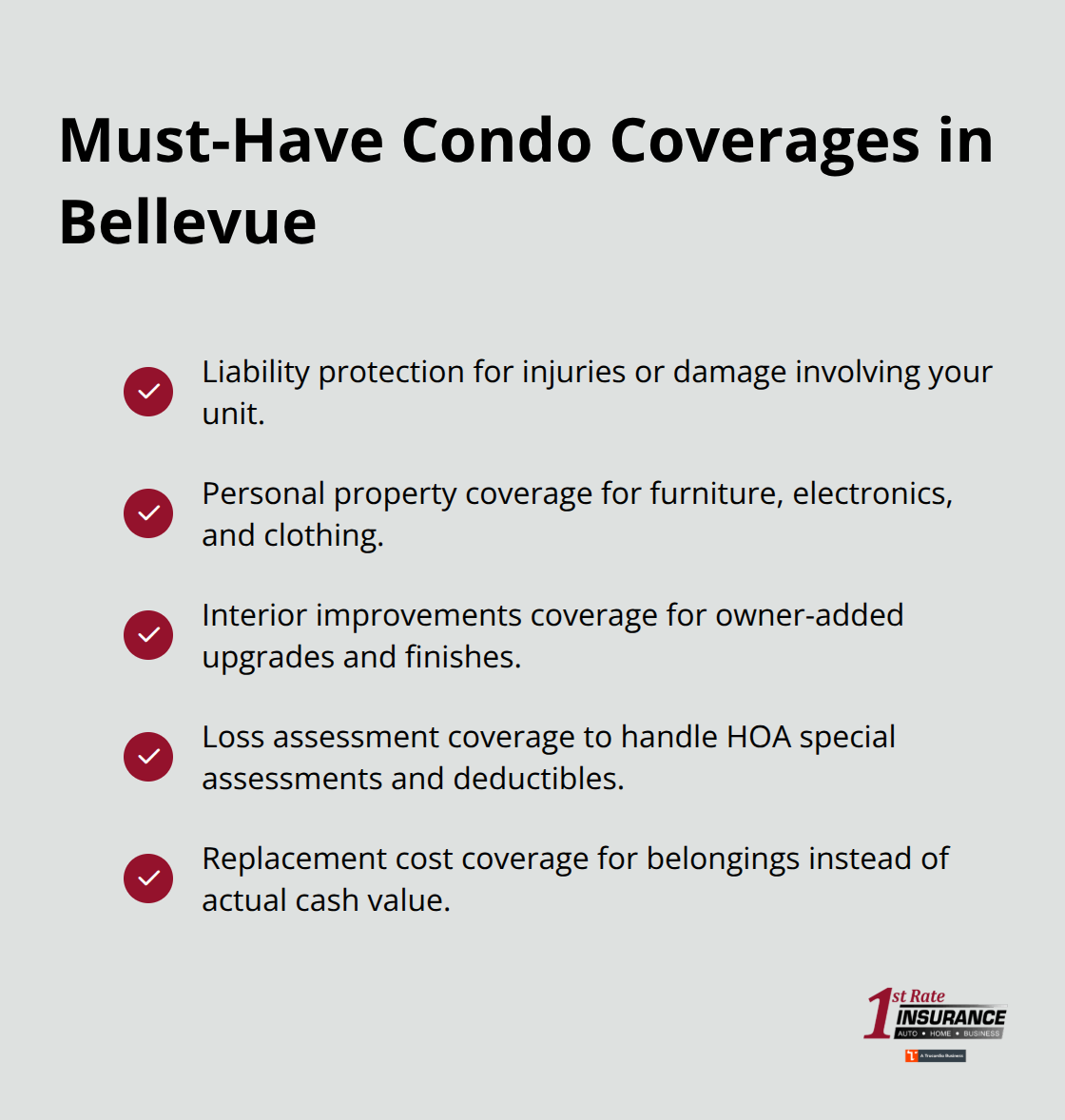
Conduct a room-by-room inventory of furniture, electronics, clothing, and collectibles to establish an accurate baseline, then add 20 percent for items you initially overlooked. Replacement cost coverage reimburses you for what items cost today, while actual cash value coverage deducts depreciation, making replacement cost substantially superior despite the 15 to 20 percent premium increase. Special limits apply to high-value items like jewelry, firearms, or art, typically capping reimbursement at $1,500 to $2,500 per item unless you add scheduled personal property endorsements.
Interior Improvements and Assessment Coverage
Interior improvements coverage protects renovations and upgrades you’ve made beyond the unit’s original condition, covering custom flooring, built-in shelving, or upgraded appliances that the HOA policy completely ignores. This coverage often gets overlooked because owners assume their improvements belong to the building, yet most condo associations explicitly exclude owner-installed upgrades from their policies.
Assessment coverage protects you when the HOA levies special assessments following major damage to the building structure, a genuine risk in Bellevue’s aging condo complexes. Without this protection, you could face bills reaching $10,000 to $50,000 if the building’s master policy deductible or coverage limits fall short after a fire, earthquake, or major weather event.
Final Thoughts
Bellevue condo insurance WA protects your unit, personal belongings, and financial security in ways standard homeowners policies cannot match. The split ownership structure between you and your HOA creates specific coverage needs that demand attention, and skipping proper protection exposes you to losses ranging from thousands to tens of thousands of dollars when damage or liability claims occur. Your action plan starts with gathering documentation from your HOA about the master policy, then requesting identical quotes from multiple carriers to reveal the 30 to 50 percent price variations that exist for the same coverage.
Bundle your condo policy with auto insurance, install safety devices, and ask about claims-free discounts to lower your premium meaningfully. Verify that your quotes include loss assessment coverage, personal property protection matching your actual belongings, and liability limits adequate for your assets and situation. The difference between adequate protection and financial disaster often comes down to local expertise and understanding which carriers price competitively for your specific building.
Contact First Rate Insurance Plus, Inc. today to review your current coverage or get quotes from carriers actively competing for Bellevue condo business. Our licensed agents shop multiple carriers to find competitive pricing and tailored coverage that protects your condo investment properly. The time you invest now in securing proper protection prevents far costlier problems later.
Disclaimer: The information provided in this blog is for general informational purposes only and does not constitute legal, financial, or insurance advice. Coverage options, terms, and availability may vary. Please consult with a licensed professional for advice specific to your situation. Artificial intelligence may have been used to generate text and images in some blog articles.

