

High Net Worth Umbrella: Expanded Liability Coverage For Wealthier Lives
Your assets deserve protection that goes beyond standard policies. A high net worth umbrella policy fills the gaps that homeowners and auto insurance leave exposed, protecting your wealth when liability claims exceed ordinary coverage limits.
At First Rate Insurance Plus, Inc., we help affluent individuals understand why this extra layer of liability protection matters. The right umbrella policy can be the difference between preserving your net worth and facing significant financial loss.
What Umbrella Insurance Actually Covers
How Umbrella Policies Protect Your Assets
Umbrella insurance protects your personal assets when a liability claim exceeds the limits of your homeowners or auto policy. If someone sues you for injuries on your property or an accident you caused while driving, your standard policies cover only up to their stated limits-typically $100,000 to $300,000 for homeowners and $100,000 to $250,000 for auto. Once those limits are exhausted, you pay the remainder out of pocket. An umbrella policy picks up where your underlying coverage stops, protecting your savings, investments, rental properties, and future income from judgment claims.
What Situations Trigger Umbrella Coverage
The policy applies to most personal liability situations: a guest injured at your home, a dog bite incident, a car accident where you’re found at fault, or even defamation claims. High net worth individuals face disproportionate risk because plaintiffs’ attorneys actively pursue cases against wealthier defendants, knowing substantial assets exist to recover. A $1 million umbrella policy costs between $150 and $300 annually for most affluent homeowners, making it one of the cheapest forms of wealth protection available.
Determining Your Coverage Amount
We at First Rate Insurance Plus, Inc. recommend umbrella coverage starting at $1 million for individuals with net worth exceeding $500,000, scaling upward based on total assets and liability exposure. Your umbrella policy only activates after your underlying insurance exhausts its limits, which means you must maintain adequate homeowners and auto coverage for the umbrella to function. If your homeowners policy has a $300,000 liability limit and someone wins a $750,000 judgment against you, your homeowners insurance pays $300,000 and your umbrella covers the remaining $450,000.
Why Standard Policies Fall Short
Many carriers require minimum underlying limits-typically $300,000 for homeowners and $250,000 for auto-before they’ll issue umbrella coverage. Standard homeowners and auto policies fall short for high net worth individuals because they were designed for average households with modest assets. A serious liability claim can easily reach six or seven figures: a child drowning at your pool might result in a $2 million settlement, a car accident causing permanent disability could exceed $3 million, or a slip-and-fall on your property might settle for $1.5 million.
According to the American Association for Justice, the median jury award in personal injury cases reached $28,000 in recent years, but catastrophic injury cases frequently exceed $500,000. Your primary policies simply weren’t built to handle these scenarios. As your wealth grows, the gap between standard coverage and potential liability exposure widens-which is why understanding how umbrella policies layer on top of your existing insurance becomes essential before you select your coverage limits.
How Much Umbrella Coverage Do You Actually Need
Start With Your Total Net Worth
Determining the right umbrella limit requires honest math, not guesswork. Add together your liquid assets, investments, real estate, retirement accounts, and future earning potential, then add 25 to 50 percent as a safety margin. A high net worth individual with $2 million in assets should carry at least $2.5 to $3 million in umbrella coverage. This isn’t excessive caution; it reflects what plaintiffs’ attorneys actually pursue. The Insurance Information Institute reports that liability claims exceeding $1 million have become increasingly common in personal injury cases, particularly those involving catastrophic injuries, wrongful death, or significant property damage.
Real Claims That Exhaust Standard Coverage
A swimming pool drowning, a dog bite causing permanent scarring, or a car accident paralyzing someone can generate settlements between $2 and $5 million. Your $300,000 homeowners policy evaporates instantly in these scenarios, leaving your personal assets exposed. The National Association of Insurance Commissioners data shows that defense costs alone in serious personal injury cases average $50,000 to $150,000 before any settlement payment occurs.
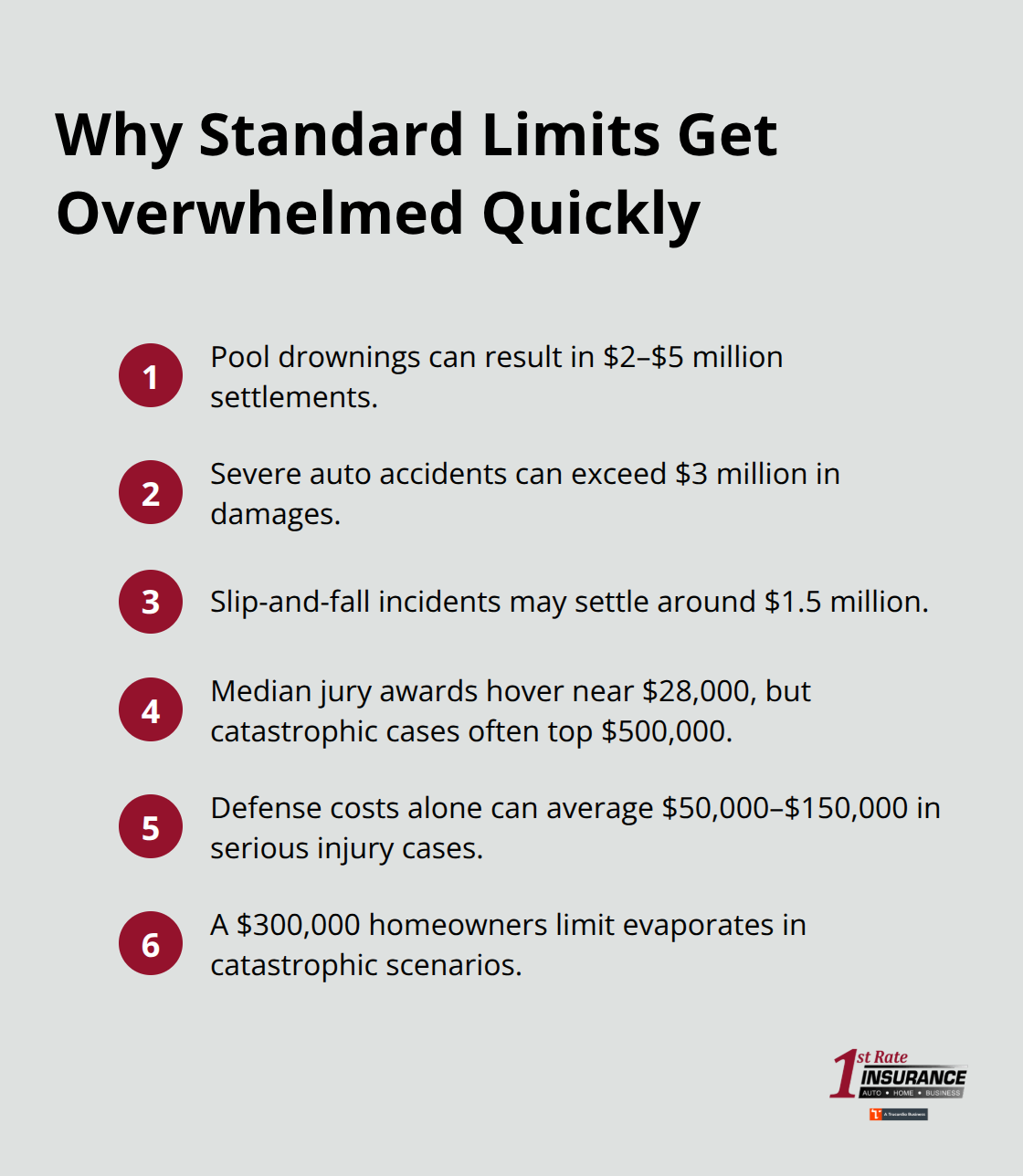
Your umbrella policy covers both the judgment and defense costs, which is why carrying adequate limits prevents a single incident from decimating decades of wealth accumulation.
How Underlying Limits Stack With Umbrella Coverage
Most carriers require your underlying homeowners and auto policies to maintain specific minimum limits-typically $300,000 to $500,000-before they’ll attach umbrella coverage to your account. This matters because umbrella policies work as a stacking mechanism: they only pay after your underlying coverage exhausts. A $1 million umbrella policy with a $300,000 homeowners limit means you’re genuinely protected for $1.3 million total, not $1 million.
Hidden Liability Exposures High Net Worth Individuals Miss
High net worth individuals often underestimate exposure because they focus on obvious risks like swimming pools or trampolines while ignoring less visible liability sources. A guest slips on your driveway, your teenage driver causes a multi-car accident, or someone gets injured at a rental property you own-these situations generate six-figure legal fees and settlements regularly. The gap between what you think you’re protected for and what you actually face can be substantial, which is why selecting your coverage limits demands careful attention to your specific assets and activities.
Selecting Your Umbrella Limits Based on Actual Assets
Your net worth determines your umbrella floor, not your gut feeling. Start by calculating liquid assets, investment accounts, real estate equity, and retirement funds, then add your expected earnings over the next decade. A high net worth individual with $3 million in investable assets and $500,000 annual income should carry minimum $4 million in umbrella coverage. This isn’t conservative thinking; it’s matching your protection to what plaintiffs’ attorneys will pursue. Insurance Information Institute data shows that personal injury verdicts regularly reach $2 to $4 million in catastrophic cases, and high net worth defendants face disproportionate exposure because settlements target maximum recovery from available assets. Try calculating your umbrella need as your total net worth plus three to five years of anticipated income, then round up to the nearest million. A $2.5 million net worth individual typically needs $4 to $5 million in coverage, not the $1 million policies many affluent homeowners incorrectly assume is sufficient.
Matching Coverage to Your Specific Risks
Your lifestyle creates specific liability exposure that generic coverage recommendations ignore. Swimming pools, rental properties, teenage drivers, or high-traffic entertaining substantially increase your claim probability. The National Association of Insurance Commissioners found that homeowners with pools face three times higher liability claims than those without. If you own rental property, your exposure multiplies because tenants and their guests present additional injury scenarios beyond your primary residence. Teenage drivers represent the highest-risk demographic on roads; the CDC reports that motor vehicle crashes are the leading cause of death for teenagers, meaning a serious accident involving your teenage driver could generate significant damages. Your umbrella limits should reflect these specific activities, not just your raw net worth.
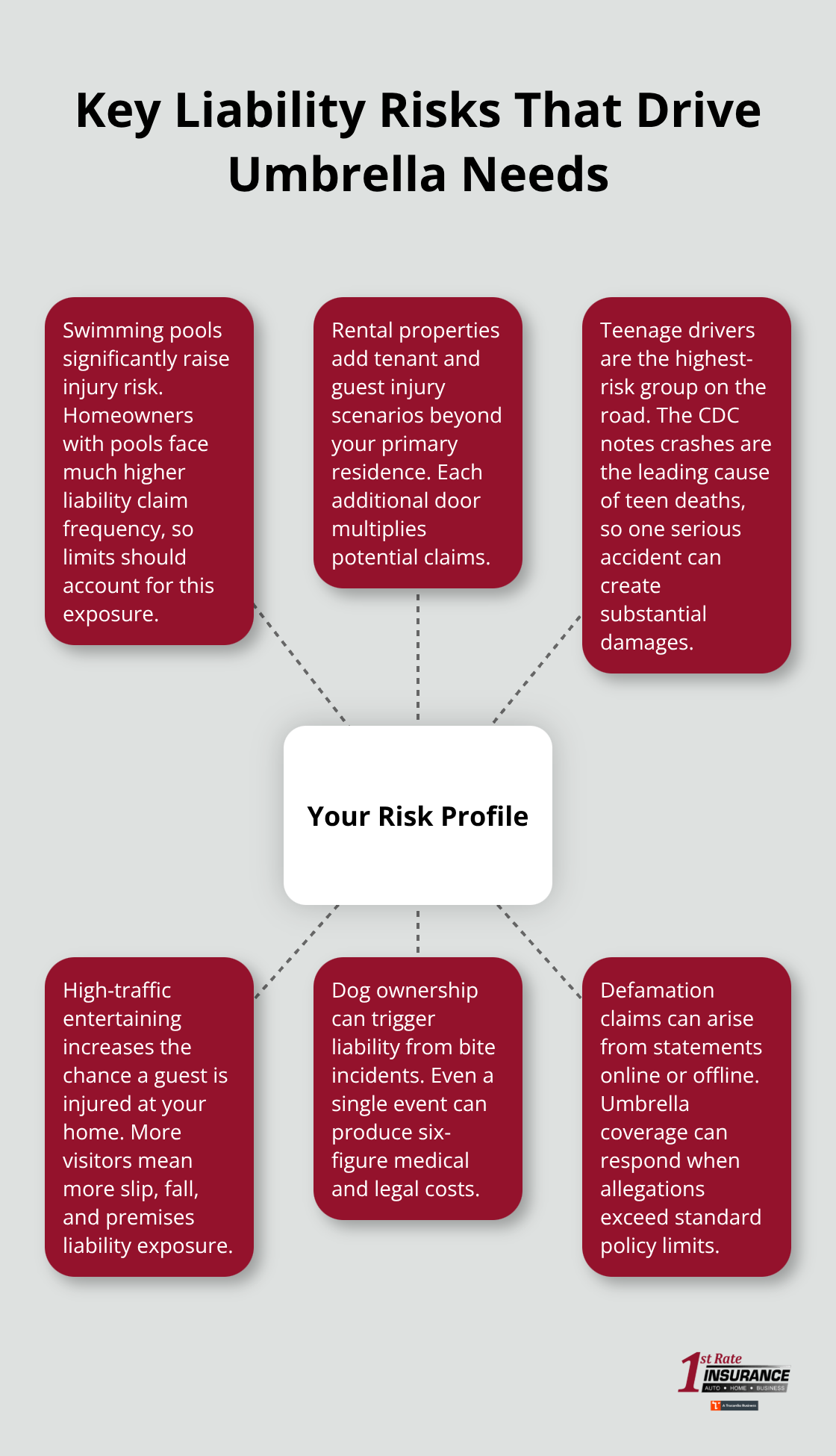
Someone with $2 million in assets but no pools, rentals, or young drivers might adequately carry $2 to $3 million in coverage, while someone with identical assets plus a pool and rental property should carry $4 to $5 million.
Comparing Carriers on Coverage Quality, Not Just Price
Umbrella policies appear commoditized until you examine actual policy language, and this is where carrier selection matters tremendously. Some insurers exclude coverage for rental properties, impose strict limits on liability defense costs, or require unreasonably high underlying limits before attaching umbrella coverage. Others provide broader protection, cover defense costs outside policy limits, and allow lower underlying minimums. The difference between a $200 annual premium and a $250 premium often reflects these coverage gaps, not simply carrier profit margins. Request specimen policies from multiple carriers and have your insurance agent compare specific exclusions, defense cost handling, and underlying limit requirements.
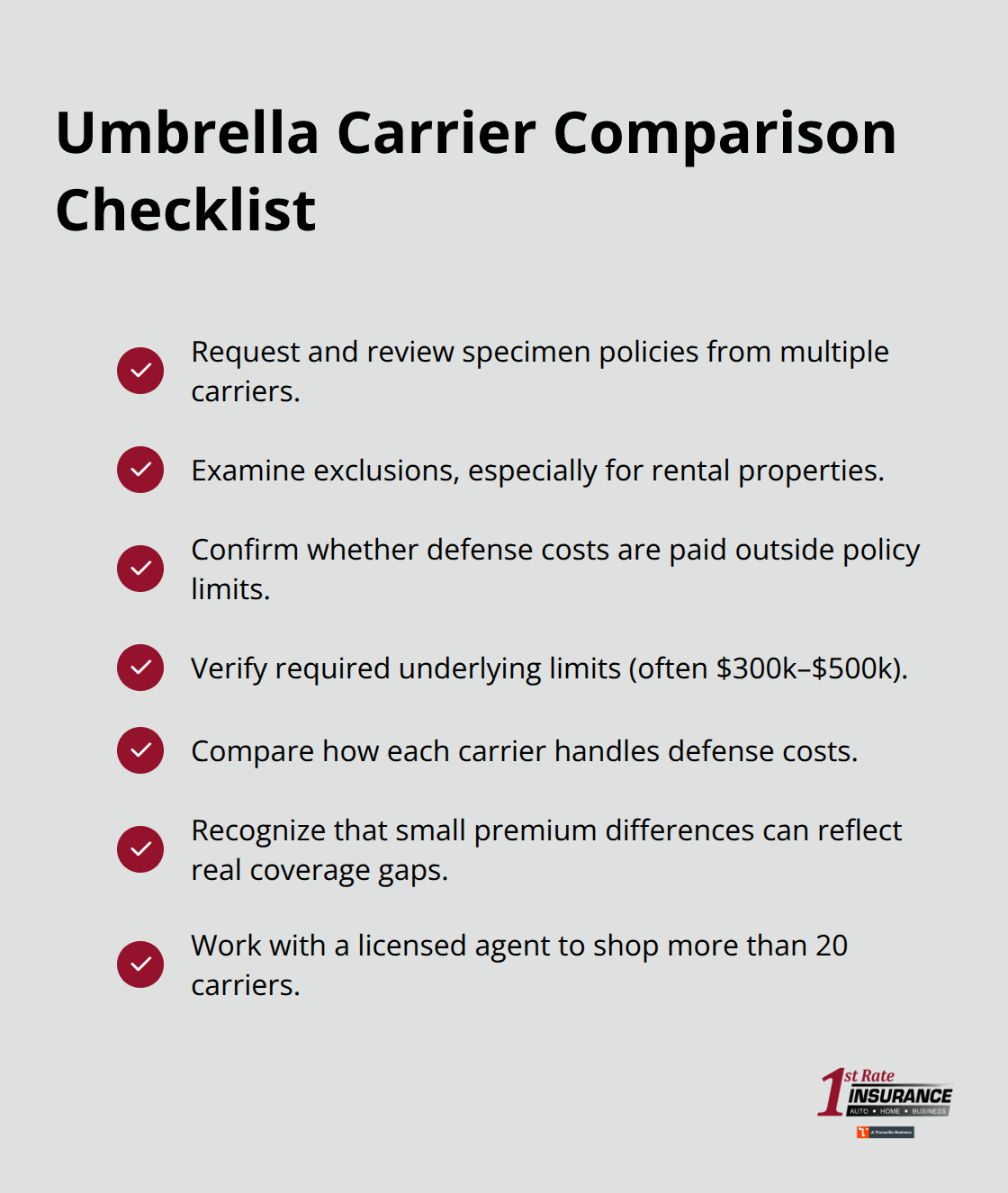
Some carriers require $500,000 underlying homeowners limits while others accept $300,000, which materially affects your total protection and premium costs. Licensed agents shop more than 20 carriers to find policies matching your specific asset profile and risk exposure, which means you avoid paying for exclusions that don’t apply to your situation while securing coverage for exposures you actually face.
Final Thoughts
High net worth umbrella coverage protects what you’ve built from a single liability claim that standard policies can’t handle. Without this layer of protection, a serious accident or injury on your property forces you to liquidate investments, sell real estate, or tap retirement accounts to satisfy a judgment. Umbrella policies cost $150 to $300 annually while protecting millions in assets, making them the most cost-effective wealth preservation tool available to affluent individuals.
Assessing your coverage needs starts with calculating your total net worth, then adding three to five years of anticipated income. Factor in specific liability exposures like swimming pools, rental properties, or teenage drivers, which substantially increase claim probability. Your lifestyle determines your actual risk profile, not generic recommendations based solely on asset value.
The next step involves reviewing your current homeowners and auto policy limits to confirm they meet your carrier’s minimum requirements ($300,000 to $500,000 for most insurers). Request specimen policies from multiple carriers and compare their specific exclusions, defense cost handling, and underlying limit requirements-these details separate adequate coverage from genuine protection. Contact First Rate Insurance Plus, Inc. to assess your high net worth umbrella needs and secure the liability protection your wealth demands.
Disclaimer: The information provided in this blog is for general informational purposes only and does not constitute legal, financial, or insurance advice. Coverage options, terms, and availability may vary. Please consult with a licensed professional for advice specific to your situation. Artificial intelligence may have been used to generate text and images in some blog articles.

